8 Best AI Cybersecurity Tools for 2026


Choosing the right AI cybersecurity tools means matching platform capabilities to your highest-risk use cases, budget, integrations, and security operating model. This guide compares eight leading AI security platforms for 2026 across threat detection, endpoint protection, exposure management, SOC automation, pricing expectations, and implementation fit so you can shortlist the right tool for your stack. For teams comparing AI-powered exposure management platforms, this decision also includes how well each option prioritizes exploitable risk across the full attack surface. AI-driven programs also benefit from consolidating security tools so findings, context, and remediation workflows stay connected.
Short answer: The best AI cybersecurity tool depends on your use case: Hive Pro Uni5 Xposure Platform with Unictor AI for CTEM and exposure management, CrowdStrike or SentinelOne for endpoint protection, Darktrace or Vectra AI for network detection, Microsoft Security Copilot for Microsoft-heavy environments, IBM QRadar for SIEM/SOAR, and Palo Alto Cortex XSIAM for SOC automation. Jump to the AI cybersecurity tools comparison table.
TL;DR: Best AI Cybersecurity Tools
TL;DR: Choose AI cybersecurity tools by use case, not by AI claims alone. Hive Pro Uni5 Xposure fits exposure management and risk prioritization, CrowdStrike and SentinelOne fit endpoint protection, Darktrace and Vectra fit network detection, Microsoft Security Copilot fits Microsoft-heavy teams, and Cortex XSIAM or IBM QRadar fit SOC and SIEM workflows.
Key Takeaways
- Focus on prevention, not just reaction: AI security tools empower your team to get ahead of threats. By using predictive analytics and real-time analysis, you can anticipate future attacks and fix the most critical vulnerabilities before they're exploited.
- View AI as a force multiplier for your team: AI isn't here to replace your security analysts; it's here to make them more effective. It handles the high-volume data analysis, which allows your team to apply their expertise to complex threat hunting and strategic investigations.
- Plan your implementation for long-term success: A powerful AI tool is only effective if it's properly integrated. Create a clear plan that covers how the tool will connect with your existing stack, how you'll train your team, and how you'll measure its performance to guarantee a strong return on investment.
What Are AI Cybersecurity Tools?
AI cybersecurity tools are security platforms that use machine learning, automation, generative AI, or predictive analytics to detect threats, prioritize risk, investigate alerts, and accelerate response. The best tool depends on whether the team needs exposure management, endpoint protection, SOC automation, network detection, or SIEM support.
AI cybersecurity tools use artificial intelligence and machine learning to protect your organization's digital assets. These platforms monitor networks, spot threats, automate responses, and predict future attacks by sifting through enormous amounts of data to find anomalies and patterns that would be impossible for a human team to catch. You've likely heard of some of them, like Microsoft Security Copilot or Darktrace, which use AI to deliver real-time insights and build a more proactive defense. Instead of just reacting to alerts, these systems help you get ahead of threats before they can cause damage.
The Rise of AI in Security
The integration of AI is fundamentally changing how we approach security. It's not just about building higher walls; it's about making them smarter. AI systems can enhance threat detection by learning what normal network activity looks like and instantly flagging deviations. This dramatically cuts down response times, allowing security teams to act faster and more decisively. AI also analyzes data at a speed and scale that humans simply can't match, turning a flood of information into clear, actionable intelligence. Organizations running a modern continuous threat exposure management (CTEM) program are increasingly relying on AI to shift from a reactive posture to a proactive one.
Where Traditional Security Falls Short
Let's be honest: traditional security measures are struggling to keep up. They often fall behind on persistent threats like sophisticated phishing campaigns, new malware variants, and the simple-but-effective weak password. These ongoing cybersecurity challenges show why a more dynamic approach is necessary. The problem is that legacy tools often generate a mountain of alerts, leaving teams to manually sort through the noise. Furthermore, the effectiveness of any AI system hinges on the quality of its data. Without clean, relevant data, even the most advanced AI can produce misleading results and send your team down the wrong path. If scanner sprawl is the bottleneck, evaluate simpler alternatives to legacy vulnerability scanners that consolidate exposure data and remediation priorities.
The Key Benefits of AI-Powered Security
Adopting AI-powered security tools brings some significant advantages to the table. The most immediate benefit is the combination of real-time analysis and automation. This pairing leads to much faster threat detection and response, helping your team stay ahead of fast-moving cyber threats. These tools don't just look at the present; they analyze historical data to predict future attacks, which strengthens your overall preparedness. By automating routine tasks and prioritizing the most critical vulnerabilities, AI frees up your security professionals to focus on strategic initiatives. This is the core idea behind a modern threat exposure management platform, which helps you focus on imminent risks instead of chasing every single alert.
What AI Tools Are Used in Cybersecurity?
AI tools in cybersecurity span several categories, each addressing a different layer of defense. The most common categories include:
- Endpoint Detection and Response (EDR): Platforms like CrowdStrike Falcon and SentinelOne use AI to monitor devices, detect malware, and automatically contain threats on laptops, servers, and cloud workloads.
- Network Detection and Response (NDR): Tools like Darktrace and Vectra AI learn normal traffic patterns and flag anomalies that indicate lateral movement, data exfiltration, or command-and-control activity.
- Security Information and Event Management (SIEM): AI-enhanced SIEMs like IBM QRadar correlate logs from across your environment to surface high-priority incidents and reduce alert fatigue.
- Threat Exposure Management: Platforms like Hive Pro Uni5 Xposure use AI to continuously assess your external attack surface, prioritize vulnerabilities based on real-world exploit intelligence, and validate your defenses through breach simulation.
- AI Security Assistants: Tools like Microsoft Security Copilot use natural language processing to help analysts investigate incidents, summarize alerts, and automate response playbooks.
The best cybersecurity programs combine tools from multiple categories to create layered, AI-augmented defenses across their entire attack surface.
What are the top 3 AI tools for cybersecurity? For most enterprise teams, the top three categories to evaluate are Hive Pro Uni5 Xposure for AI-powered CTEM and exposure prioritization, a leading endpoint or XDR platform such as CrowdStrike Falcon or SentinelOne, and a SOC analytics or automation platform such as Microsoft Security Copilot, IBM QRadar, or Palo Alto Cortex XSIAM. The right shortlist depends on whether your biggest gap is exposure management, endpoint response, network detection, or SOC workflow automation.
How can AI be used in cyber security? AI can correlate high-volume security data, detect abnormal behavior, prioritize exploitable vulnerabilities, validate controls through breach and attack simulation, summarize incidents for analysts, and automate remediation workflows. The strongest programs use AI to help analysts make faster, better-contextualized decisions rather than replacing human oversight.
What are the top 3 AI cybersecurity tools? For enterprise teams, the top three usually depend on the security operating model: Hive Pro Uni5 Xposure for AI-powered CTEM and exposure prioritization, CrowdStrike Falcon or SentinelOne Singularity for endpoint and XDR protection, and Microsoft Security Copilot for analyst productivity in Microsoft-centric SOCs. Teams with network detection requirements should also compare Darktrace and Vectra AI.
How to Choose the Best AI Cybersecurity Tool
When you're ready to add an AI-powered tool to your security stack, it's easy to get lost in technical specs and marketing promises. Not all AI solutions are built the same, and the right one for your organization should feel less like another piece of software and more like a highly intelligent extension of your team. The goal is to find a tool that doesn't just add another layer of complexity but actually simplifies your operations and strengthens your defenses in a measurable way.
Think of your evaluation process as a checklist for a new strategic partner. You need a tool that is fast, forward-thinking, and efficient. It must work well with the systems you already have in place and be capable of growing alongside your organization. Most importantly, it needs to be usable. A powerful engine is useless if your team can't interpret the data it produces.
Threat Detection and Response
Modern cyberattacks move at machine speed, and your defenses need to do the same. The single biggest advantage of AI is its ability to process and correlate massive amounts of data in real time. Look for a tool that can continuously monitor your network traffic, user behavior, and system logs to spot anomalies the moment they occur. This isn't just about flagging known signatures; it's about identifying subtle deviations from the baseline that could indicate a novel or emerging threat. An effective AI tool automates threat detection and response, enabling a proactive defense that can neutralize threats before they cause significant damage.
AI-Powered Vulnerability and Threat Prioritization
The best defense is knowing what's coming next. Go beyond tools that only react to current threats and seek out those with strong predictive capabilities. Powered by machine learning, these systems analyze historical attack data and current threat intelligence to forecast potential future attacks. They use behavior-based analytics to understand what's normal for your environment and can predict which vulnerabilities are most likely to be targeted by attackers. This foresight allows your team to shift from a reactive posture to a proactive one, focusing your resources on shoring up the weaknesses that pose the most imminent risk. This is a key part of vulnerability and threat prioritization.
Automation Capabilities
Your security team is your most valuable asset, but they're likely buried in manual tasks and drowning in alerts. A great AI security tool should lighten that load through intelligent automation. Look for features that can automate routine processes like threat triage, risk scoring, and even initial incident response actions. By handling the repetitive, high-volume work, the AI system frees up your human analysts to concentrate on what they do best: complex threat hunting, strategic planning, and in-depth investigations. This not only makes your team more efficient but also helps reduce your mean time to remediate.
Integrations and Data Coverage
A new security tool should not create another data silo. For an AI solution to be truly effective, it must integrate smoothly with your existing security infrastructure, including your SIEM, SOAR, firewalls, and ticketing systems. It should also cover specialized use cases like API security testing without requiring yet another standalone product. This ensures a unified view of your security posture and allows for a more coordinated response. When evaluating tools, check their APIs and pre-built integrations. A solution that easily connects to your current stack will provide a much higher return on investment and a smoother workflow, preventing the need for costly custom development or hiring specialized experts just to get it running.
Scalability for Future Growth
Your organization isn't static, and your security tools shouldn't be either. As your business grows, so will your attack surface, data volume, and the complexity of your IT environment. The AI security tool you choose must be able to scale effortlessly to meet these future demands without a decline in performance or an unexpected surge in costs. Ask potential vendors about their architecture. A scalable, cloud-native solution ensures that your security capabilities can keep pace with your growth, providing consistent protection for your entire attack surface for years to come. Security teams building a proactive program can also review leading CTEM vendors to compare how different platforms support continuous risk reduction.
Scalability and Deployment Fit
Advanced AI is incredibly complex, but using it shouldn't be. The most powerful tool is ineffective if your team finds it difficult to use or interpret its findings. Look for a solution with a clean, intuitive user interface that translates vast amounts of data into clear, actionable insights. Dashboards should provide an at-a-glance view of your security posture, reports should be easy to generate and understand, and workflows should feel logical. A user-friendly interface empowers your entire team to make faster, more confident decisions.
AI Cybersecurity Tools Comparison Table
Choosing the right AI security tool can feel overwhelming with so many options on the market. To help you cut through the noise, here's a comparison of eight platforms that security teams rely on today. Each tool brings something different to the table, from proactive exposure management to real-time endpoint protection.
Quick Comparison Table
ToolBest FitPrimary AI use caseSecurity categoryEnterprise fitNotable limitationHive Pro Uni5Threat Exposure ManagementThreat prioritization, BAS, attack path analysisCTEM programs, unified exposure managementHighRequires CTEM process ownership to realize the full platform value.Microsoft Security CopilotAI Security AssistantNLP-powered investigation, automated playbooksMicrosoft-heavy environmentsHigh for Microsoft-centric enterprisesLess natural fit for teams outside the Microsoft security ecosystem.DarktraceNDR / Autonomous ResponseSelf-learning AI, autonomous containmentNovel threat detection, insider threatsHighNeeds baselining and tuning before autonomous response is trusted.SentinelOneEDR / XDRBehavioral AI, automated rollbackEndpoint protection, ransomware defenseHighEndpoint-centric coverage may not solve broader exposure management gaps.CrowdStrike FalconEDR / XDRThreat graph, predictive analyticsLarge-scale endpoint securityHighStrong endpoint value, but broader modules can increase complexity and cost.IBM QRadarSIEM / SOARUser behavior analytics, automated triageSOC operations, log correlationHigh for mature SOCsRequires high-quality log coverage and ongoing SOC tuning.Palo Alto Cortex XSIAMSIEM + SOC AutomationML-driven analytics, automated investigationSOC modernization, alert consolidationHigh for SOC modernizationWorks best when telemetry and automation programs are already mature.Vectra AINDRAttack signal intelligence, behavioral analysisNetwork threat detection, hybrid cloudHigh for network-heavy environmentsRequires strong network and cloud telemetry coverage.
Hive Pro Uni5 Xposure Platform
Hive Pro's Uni5 Xposure Platform is a continuous threat exposure management platform designed to shift your security posture from reactive to proactive. Instead of just waiting for alerts, it helps you get ahead of threats by continuously managing your threat exposure across all five stages of the CTEM framework: scope, discover, prioritize, validate, and mobilize. The platform combines six native scanners with 50+ integrations, HiveForce Labs intelligence, vulnerability and threat prioritization, and mobilization workflows that support security operations teams from risk discovery through remediation.
A key feature is its advanced Breach and Attack Simulation (BAS) capability through adversarial exposure validation, which lets you safely mimic the attack paths and techniques that real adversaries use. The platform's proprietary Unictor AI risk scoring engine goes beyond generic CVSS scores by factoring in real-world exploit intelligence from HiveForce Labs, asset criticality, and active threat actor targeting. By providing a unified view of your cyber risks, Uni5 helps your team focus on the vulnerabilities that matter most and facilitates remediation through automated workflows that can cut response time by up to 70%.
Microsoft Security Copilot
For teams heavily invested in the Microsoft ecosystem, Microsoft Security Copilot acts as a powerful AI assistant. It processes vast amounts of security data to identify threats and recommend clear, actionable steps for remediation. Its main strength lies in its seamless integration with other Microsoft security tools, like Sentinel and Defender. This allows it to quickly summarize complex incidents, analyze scripts, and guide analysts through response workflows using natural language. It's designed to help security teams work more efficiently by simplifying investigation and response, making it a valuable addition for organizations looking to get more out of their existing Microsoft security stack.
Darktrace Enterprise
Darktrace takes a unique approach with its Enterprise Immune System. Instead of relying on predefined rules, its AI learns the normal pattern of life for your entire digital environment, from networks and cloud infrastructure to endpoints. Once it establishes this baseline, Darktrace can spot subtle deviations that signal an emerging threat, even from novel or sophisticated attackers. What makes it stand out is its ability to take autonomous action to contain threats in real time, neutralizing attacks before they can cause damage. This makes it particularly effective for catching insider threats and other tricky attacks that might otherwise go unnoticed by traditional security tools.
SentinelOne Singularity
SentinelOne's Singularity Platform is a leader in endpoint security, offering robust protection for a wide range of devices, from laptops and servers to cloud workloads. It uses AI-powered behavioral analysis to detect and stop ransomware, malware, and other advanced threats in their tracks. The platform excels at automating threat hunting and incident response. When a threat is detected, it can immediately kill the malicious process, quarantine the file, and even roll back the affected device to its pre-infection state. This real-time, autonomous response capability helps security teams contain threats quickly across their entire fleet of endpoints.
CrowdStrike Falcon
The CrowdStrike Falcon platform is another top contender in the endpoint security space, built from the ground up as a cloud-native solution. This architecture makes it lightweight, scalable, and easy to deploy without requiring on-premises hardware. Falcon combines next-generation antivirus, endpoint detection and response (EDR), and a 24/7 managed threat hunting service all in one platform. It leverages AI and a massive threat graph to analyze trillions of events per week, allowing it to detect and respond to threats with incredible speed and accuracy. Its strong integration of threat intelligence helps organizations stay ahead of emerging adversary tactics.
IBM QRadar
IBM QRadar is a well-established Security Information and Event Management (SIEM) platform that uses AI to make sense of the massive volumes of log and event data generated across an organization. It correlates information from network devices, servers, and applications to identify potential security incidents. Where AI comes in is by enhancing threat detection with user behavior analytics and automating the initial stages of incident analysis. This provides security teams with prioritized, actionable insights, helping them focus on the most critical threats. QRadar helps reduce alert fatigue and speeds up investigation times, making it a cornerstone for many security operations centers (SOCs).
Palo Alto Networks Cortex XSIAM
Palo Alto's Cortex XSIAM (Extended Security Intelligence and Automation Management) represents a new approach to SOC operations. It combines SIEM, SOAR, ASM, and threat intelligence into a single AI-driven platform designed to replace the traditional SOC stack. The platform ingests data from across your environment and uses machine learning to automatically stitch together related alerts, investigate incidents, and recommend response actions. Cortex XSIAM claims to reduce alert volume by up to 98% and cut investigation time from days to minutes. It's a strong fit for enterprise organizations looking to modernize their SOC and reduce the manual workload on their analysts.
Vectra AI
Vectra AI focuses on network detection and response, using its proprietary Attack Signal Intelligence to find attackers already inside your environment. Rather than relying on signatures or known indicators of compromise, Vectra's AI analyzes network behavior across on-premises, cloud, and hybrid environments to detect lateral movement, privilege escalation, and data exfiltration in real time. The platform assigns threat and certainty scores to every detection, helping analysts prioritize the most urgent incidents. Vectra is particularly strong at detecting advanced persistent threats and sophisticated attacks that blend in with normal traffic patterns.
Which AI Cybersecurity Tool Should You Choose?
Choose the AI cybersecurity tool that matches the risk you need to reduce first. Select Hive Pro Uni5 Xposure for AI-assisted exposure prioritization and CTEM, CrowdStrike or SentinelOne for endpoint protection, Darktrace or Vectra AI for network detection, Microsoft Security Copilot for Microsoft-native investigation, and QRadar or Cortex XSIAM for SOC analytics and automation.
How Does AI Improve Cybersecurity?
AI improves cybersecurity by addressing the three biggest challenges security teams face today: speed, scale, and accuracy.
Speed: AI processes and correlates security events in milliseconds. While a human analyst might take 20 minutes to triage a single alert, AI can evaluate thousands of events per second and surface only the most critical findings. For organizations tracking cybersecurity metrics like mean time to detect (MTTD) and mean time to respond (MTTR), AI-powered tools consistently deliver measurable improvements.
Scale: The average enterprise generates over 10,000 security alerts per day. No human team can process that volume without missing critical events. AI handles this data flood by correlating signals across endpoints, networks, cloud workloads, and user behavior to build a complete picture of what's happening in your environment. This is why continuous monitoring powered by AI has become table stakes for mature security programs.
Accuracy: Machine learning models trained on billions of security events can distinguish between genuine threats and benign anomalies with far greater precision than rule-based systems. This reduces false positives, which is one of the primary drivers of analyst burnout and security team turnover.
Beyond these core improvements, AI enables capabilities that simply weren't possible with traditional tools:
- Attack path analysis: AI can map how vulnerabilities chain together to reach critical assets, helping teams prioritize remediation based on actual exploitability.
- Predictive threat intelligence: By analyzing global threat data and your specific environment, AI can forecast which vulnerabilities are most likely to be targeted next.
- Automated response: AI-driven playbooks can contain threats in seconds, isolating compromised endpoints or blocking malicious IPs without waiting for human intervention.
AI Security in Action: Industry Use Cases
Theory is great, but seeing how AI-powered security tools perform in the real world is what truly matters. Different industries face unique threats and compliance requirements, and AI's adaptability makes it a powerful ally across the board.
Protecting Patient Data in Healthcare
The healthcare industry is a prime target for cyberattacks due to the high value of protected health information (PHI). AI-powered security tools are essential for safeguarding this sensitive data. By continuously analyzing network traffic and user behavior, AI can automate threat detection and identify anomalies that might indicate a breach, like unauthorized access to patient records. This allows security teams to respond faster and more effectively, fortifying their defenses against ransomware and other evolving risks.
Securing Transactions in Financial Services
In financial services, the speed and security of transactions are paramount. A single breach can have devastating consequences. AI security systems offer real-time protection against emerging threats. These tools can analyze millions of transactions in seconds, detecting fraudulent patterns and suspicious activities that would be impossible for human analysts to catch. By using AI to prioritize threats, financial institutions can focus their resources on the most significant risks, protecting their networks and client assets.
Guarding Operations in Manufacturing and OT
Manufacturing environments increasingly rely on connected operational technology (OT), which creates new entry points for attackers. AI enhances industrial cybersecurity by automating threat detection and response in complex OT networks. It can learn the baseline behavior of industrial control systems and immediately flag any deviations. This allows companies to save time and resources, moving from a reactive to a proactive defense of their critical operational assets.
Defending Customer Information in Retail
Retail businesses handle enormous volumes of customer data, from personal details to payment information, making them attractive targets for cybercriminals. AI is a game-changer for retail cybersecurity, automating the detection of threats like sophisticated phishing campaigns aimed at stealing credentials. By analyzing customer behavior and transaction patterns, AI can quickly identify and block fraudulent activities. A strong threat exposure management platform can provide the unified view needed to manage these diverse risks.
Safeguarding Critical Infrastructure in Energy
The energy sector underpins our entire economy, making its cybersecurity a matter of national security. AI tools are indispensable for providing the real-time monitoring and proactive defense needed to protect these vital systems. By analyzing data from across the attack surface, AI can identify potential threats before they can cause damage. This strategic approach is essential as industrial enterprises face a rising tide of cybersecurity threats and attacks.
Common Myths About AI Security Tools
As AI becomes more integrated into cybersecurity, it's easy to get tangled in the hype. Let's separate fact from fiction so you can make informed decisions.
Myth: AI Will Replace Human Analysts
This is one of the most persistent myths out there. The reality is that AI is a powerful partner for your security team, not a replacement. Think of it as a force multiplier that handles the heavy lifting of sifting through massive datasets to find potential threats. This frees up your analysts to focus on what they do best: strategic thinking, complex investigation, and decision-making. AI is designed to augment human capabilities, handling the repetitive tasks so your experts can apply their skills where it matters most.
Myth: AI Is Always 100% Accurate
AI is incredibly powerful, but it isn't perfect. An AI system's effectiveness is directly tied to the quality of the data it's trained on. If the data is flawed or incomplete, the AI can produce misleading results or false positives. This is why human oversight is critical. Your analysts must be able to validate the AI's findings, fine-tune its algorithms, and provide the context that a machine might miss. Treat AI-generated alerts as highly qualified leads, not as absolute truths that require no further investigation.
Myth: Implementing AI Security Is Too Complicated
While building an AI security model from scratch is a complex undertaking, you don't have to start there. Modern AI-powered security platforms are designed for easier integration into your existing stack. The key is choosing a solution that fits your environment and having a clear plan. Many vendors provide the support and expertise needed to get you up and running without becoming a machine learning expert overnight.
Myth: AI Tools Are Too Expensive
The sticker price of an AI security tool can seem high, but it's important to consider the return on investment. High implementation costs are a valid concern, but they are often offset by significant long-term savings. Think about the cost of a major data breach, the hours your team spends manually investigating low-level alerts, or the financial impact of operational downtime. AI-driven automation reduces incident response times, improves your team's efficiency, and helps you proactively stop threats before they cause real damage.
Myth: AI Offers Complete Security Coverage
No single tool can offer 100% protection, and AI is no exception. It's a powerful component of a defense-in-depth strategy, but it's not a silver bullet. AI excels at identifying patterns and anomalies, but it should be part of a broader security framework that includes firewalls, endpoint protection, and a skilled security team. Conducting a thorough cybersecurity risk assessment alongside AI deployment ensures you maintain layered defenses that are much harder for attackers to penetrate.
How to Implement an AI Security Tool Successfully
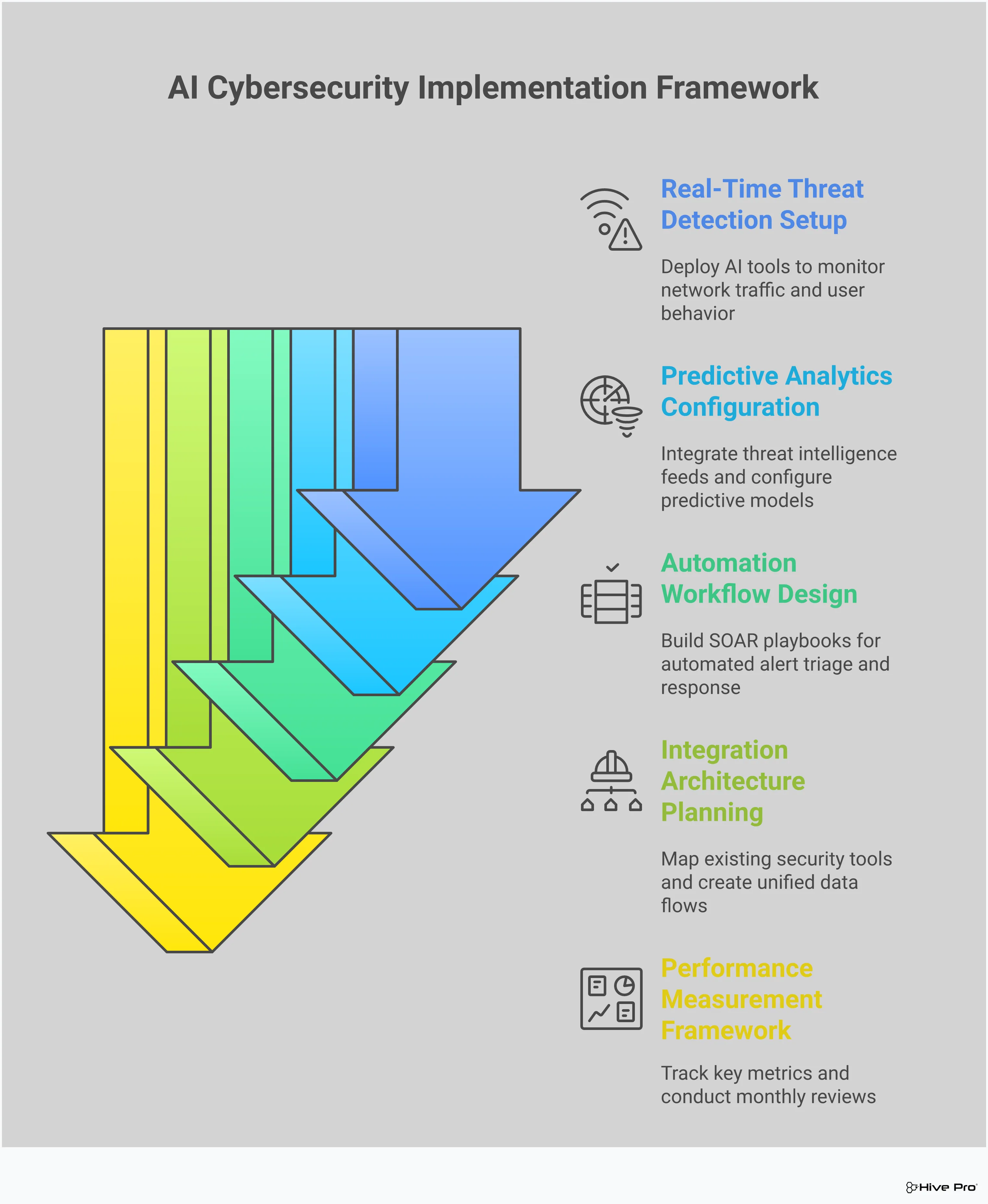
Bringing a new AI-powered tool into your security stack is more than just a technical update. A successful implementation requires a clear plan that covers everything from initial evaluation to ongoing performance monitoring.
Establish Your Evaluation Framework
Before you even look at demos, define what success looks like for your organization. Start by identifying the specific security gaps you want to close. Are you struggling with alert fatigue? Do you need to shorten your mean time to respond (MTTR)? Are you trying to get a unified view of your entire attack surface? Your goals will become the foundation of your evaluation criteria. Your framework should prioritize solutions that provide a clear, consolidated view of your cyber risks, like the Uni5 Xposure Platform, to ensure the AI has the right context to work with.
Develop a Clear Integration Strategy
A new AI tool should feel like a natural extension of your security operations, not a clunky add-on. Map out how the tool will connect with your existing SIEM, SOAR, and ticketing systems. Will it require custom APIs, or does it offer out-of-the-box integrations? Your goal is to create a seamless workflow where insights from the AI tool can be acted upon quickly. A well-planned integration prevents data silos and ensures that the tool's automated capabilities can be fully utilized. For organizations managing complex environments, a solid patch management process should run alongside your AI tooling to ensure identified vulnerabilities get fixed promptly.
Train Your Team for Success
AI is here to empower your team, not replace it. Your analysts need to understand how to work with these new capabilities. Effective training goes beyond learning a new user interface; it's about teaching your team how to interpret the AI's recommendations, validate its findings, and understand its limitations. Invest in training that helps your team build trust in the tool and use its insights to make more informed decisions. When your team understands the "why" behind the AI's output, they can operate with greater confidence and speed.
Monitor Performance and Key Metrics
Once the tool is up and running, your job isn't over. You need to continuously monitor its performance against the goals you set in your evaluation framework. Key metrics might include the reduction in false positives, the speed of threat detection, and the accuracy of vulnerability and threat prioritization. Schedule regular check-ins to review the data, gather feedback from your team, and fine-tune the tool's configuration. This iterative process ensures the tool remains aligned with your security objectives.
Manage Costs Effectively
The conversation around AI tools often includes concerns about high implementation costs. To make a smart investment, look beyond the initial price tag and consider the total cost of ownership (TCO). This includes expenses for integration, training, and ongoing maintenance. The best way to justify the cost is to demonstrate a clear return on investment (ROI). Calculate the potential savings from reduced manual effort, faster incident response, and the prevention of costly breaches.
What's Next for AI in Cybersecurity?
The world of AI in cybersecurity is moving incredibly fast. What felt like a futuristic concept just a few years ago is now a standard part of the modern security stack. For security teams, this isn't just about adopting new tools; it's about preparing for a new paradigm of threat detection, response, and management.
More Advanced Machine Learning
We're moving beyond basic machine learning models into an era of more autonomous systems. The next generation of AI tools will rely on advanced techniques like deep learning for malware detection and behavior-based analytics that can spot an anomaly without needing a pre-existing signature. These advancements are making autonomous threat detection a reality, where AI can not only identify a potential threat but also analyze its context and potential impact with minimal human intervention.
The Evolution of Predictive Analytics
AI is flipping the script on reactive cybersecurity. The evolution of predictive analytics means we can now use AI to forecast where and how attacks are likely to occur. By analyzing vast datasets of historical threats, network traffic, and global threat intelligence, AI models can identify patterns that signal a future breach. This allows teams to proactively prioritize threats and patch vulnerabilities before they can be exploited.
Smarter Breach and Attack Simulation
How do you know if your defenses will hold up against an AI-powered attack? Breach and Attack Simulation (BAS) is getting a major upgrade with AI, making security validation more dynamic and realistic. Instead of running static, predictable tests, AI-driven platforms can simulate attacks that mimic the adaptive, unpredictable nature of modern adversaries. These smart simulations can probe your entire attack surface, identify weak points in your controls, and provide clear guidance on where to focus your remediation efforts.
A Greater Focus on AI Ethics and Privacy
As we integrate AI more deeply into our security operations, conversations around ethics and privacy are becoming essential. Is the AI model biased? How are we protecting the data used to train these systems? Organizations must address these ethical considerations to build trust and ensure their AI tools are both effective and responsible. Expect to see more demand for transparency in how AI security tools make decisions.
The Rise of New AI-Powered Solutions
AI is no longer just a feature; it's becoming the foundation of modern cybersecurity. We're seeing the rise of comprehensive, AI-powered solutions that unify different security functions into a single, intelligent system. Instead of juggling dozens of disconnected tools, security teams can use unified platforms that leverage AI across the board. This trend will only accelerate as organizations seek more efficient and effective ways to manage their overall threat exposure.
How Much Do AI Cybersecurity Tools Cost?
AI cybersecurity tool pricing varies widely based on the category, deployment model, and the size of your environment. Most enterprise-grade platforms use custom pricing tied to the number of endpoints, users, or data volume, so published list prices are rare. Here is a general breakdown of what to expect across tool categories:
- Endpoint Detection and Response (EDR/XDR): SentinelOne starts around $45 per endpoint per year, while CrowdStrike Falcon begins near $60 per endpoint per year. Both offer tiered plans with additional capabilities at higher price points.
- Network Detection and Response (NDR): Darktrace and Vectra AI both use custom pricing. Expect annual contracts starting in the mid-five figures for midsized environments, scaling with network bandwidth and the number of monitored subnets.
- SIEM and SOC Automation: IBM QRadar and Palo Alto Cortex XSIAM are priced based on data ingestion volume (events per second or gigabytes per day). Entry-level deployments typically start at $20,000 to $50,000 per year.
- Threat Exposure Management: Hive Pro Uni5 Xposure uses custom pricing with a free 30-day trial. Platforms in this category generally price based on the number of assets under management and integrated scanner feeds.
- AI Security Assistants: Microsoft Security Copilot uses consumption-based pricing (Security Compute Units), so costs scale with usage. Organizations report typical monthly costs between $2,000 and $10,000 depending on query volume.
When comparing costs, look beyond the license fee. Factor in integration effort, training, and the ongoing tuning required to get accurate results. The strongest ROI case comes from measuring time saved on manual triage, faster vulnerability remediation, and breach prevention. Many teams find that consolidating three or four point tools into a single AI-powered platform reduces total cost of ownership by 30% or more.
Frequently Asked Questions About AI Cybersecurity Tools
What AI tools are used in cybersecurity?
Cybersecurity teams use AI tools for exposure management, endpoint protection, network detection, SIEM analytics, SOC automation, phishing analysis, malware detection, and incident investigation. Common examples include Hive Pro Uni5 Xposure, Microsoft Security Copilot, Darktrace, SentinelOne, CrowdStrike, IBM QRadar, Cortex XSIAM, and Vectra AI.
How is AI used in cybersecurity?
AI is used in cybersecurity to detect abnormal behavior, prioritize vulnerabilities, correlate alerts, summarize investigations, recommend response actions, and automate repetitive analysis. It works best when paired with clean telemetry, threat intelligence, validation evidence, and analyst oversight.
What are the best AI cybersecurity tools for enterprise teams?
The best enterprise AI cybersecurity tools depend on the operating model. Hive Pro Uni5 Xposure is a fit for exposure management and risk prioritization, CrowdStrike and SentinelOne for endpoint protection, Darktrace and Vectra AI for network detection, Microsoft Security Copilot for Microsoft ecosystems, and Cortex XSIAM or IBM QRadar for SOC and SIEM workflows.
Related Articles
- The Impact of Artificial Intelligence on Cybersecurity
- What Is Threat Hunting? A Complete Guide for Security Teams
- External Attack Surface Management: What It Is, Why It Matters
- Cybersecurity Risk Assessment: The Complete Guide for Security Leaders
- What Is CTEM? A Modern Approach to Cyber Risk
Frequently Asked Questions About AI Cybersecurity Tools
What are the best AI cybersecurity tools for enterprises?
The best AI cybersecurity tools depend on the job: CTEM and exposure management platforms, endpoint and XDR tools, network detection tools, SIEM and SOAR platforms, and SOC copilots each solve different problems. Enterprises should prioritize tools that integrate with existing scanners, explain risk clearly, and connect findings to measurable remediation outcomes.
How do AI cybersecurity tools help security teams?
AI cybersecurity tools help security teams triage alerts faster, prioritize risk, detect anomalies, understand attack path context, and route remediation work to the right owners. The biggest value comes when AI reduces noise rather than simply adding more findings, so teams can focus on exposures that attackers are most likely to exploit.
What is the difference between AI threat detection and exposure management?
AI threat detection looks for suspicious behavior, malicious activity, or anomalies that may indicate an attack in progress. Exposure management focuses on continuously reducing the weaknesses attackers could exploit before an incident occurs. Mature programs use both: detection for active threats and exposure management to shrink the attack surface over time.
Which AI cybersecurity tool is best for CTEM programs?
For CTEM programs, Hive Pro's Uni5 Xposure platform is built for continuous exposure reduction because it combines prioritization, HiveForce Labs threat intelligence, breach and attack simulation, attack path analysis, and remediation mobilization. That makes it a CTEM-focused option rather than a standalone detection or alerting tool.
How should teams evaluate AI cybersecurity tools?
Teams should evaluate AI cybersecurity tools by checking integrations, data quality, explainability, validation methods, remediation workflow fit, proof-of-concept results, and measurable impact on MTTR or exposure reduction. A strong evaluation should test whether the tool improves decisions for real assets and threats, not just whether it produces more AI-generated insights.
About the author
Dan Schoenbaum is Chief Marketing Officer at Hive Pro. He brings cybersecurity go-to-market leadership experience from high-growth security companies including Tripwire and RiskIQ, where he held executive leadership roles before successful acquisitions. His work at Hive Pro focuses on helping security teams understand and operationalize Continuous Threat Exposure Management.







.svg)