 Critical Threat Research : The Iranian Cyber War Intensifies!


Comprehensive Threat Exposure Management Platform
Persistent exposure backlogs do not shrink when teams chase every critical finding. Buyers need a CTEM platform that shows which risks demand action right now.
Evaluate Uni5 Xposure for a threat-informed CTEM program.
Zafran vs Hive Pro compares two CTEM platforms designed to focus security teams on exposures that pose real risk to business operations each day. Zafran brings findings together across existing tools and highlights exploitability, then uses current security controls to reduce risk before patching completes. Hive Pro’s Uni5 Xposure uses exposure assessment and adversarial exposure validation to provide a unified cyber risk view and actionable resolution pathways. That distinction matters because CTEM continuously evaluates assets for accessibility, exposure, and exploitability, rather than treating vulnerability review as a periodic exercise. The right fit depends on whether your program needs control-led mitigation, broad validated exposure context, or both in its daily workflows.
The buyer’s question is not which platform sounds broader; it is which approach maps to your exposures, controls, teams, and remediation limits. To compare capabilities without flattening either platform, start with Zafran vs Hive Pro: where each CTEM approach fits. Here’s how.
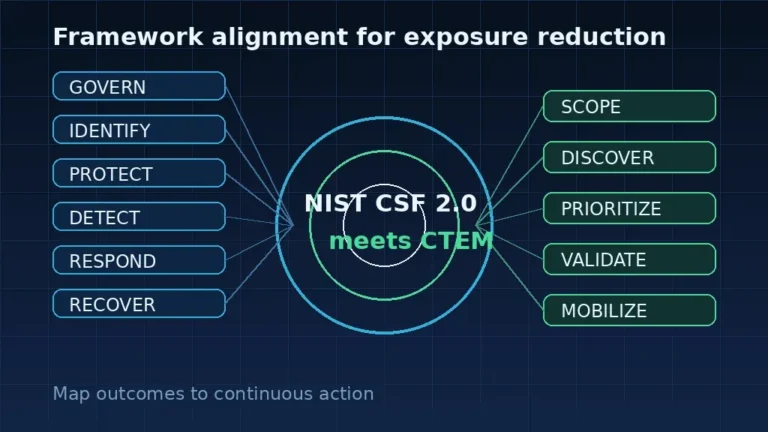
Continuous threat exposure management (CTEM) is a repeatable way to find and reduce exposure across assets, people, and processes. Its five-stage cycle is scoping, discovery, prioritization, validation, and mobilization. Discovery alone does not tell a team which fix lowers business risk first.
That aim also appears in public risk programs. CISA’s Continuous Diagnostics and Mitigation program describes ongoing risk identification, impact-based priority setting, and mitigation of major issues. For leaders comparing Zafran vs Hive Pro, the useful question is where each platform adds focus in that cycle.
Zafran’s stated position starts with controls that an organization already has in place. Its platform uses existing security controls to show ways to reduce exploitability while patch work is pending. It also joins findings from current tools and routes fix work through ticketing platforms. See the vendor’s platform overview for its stated scope.
Hive Pro Uni5 Xposure starts with a unified exposure view and adversarial validation. It connects exposure assessment with attack paths and actionable routes to resolve risk. This fits teams that need threat context and validation tied to priority setting, not a queue built from findings alone.
| Comparison point | Zafran | Hive Pro Uni5 Xposure |
|---|---|---|
| Primary emphasis. | Existing-control mitigation. | Unified exposure management. |
| Validation lens. | Control effectiveness. | Adversarial exposure validation. |
| Risk context. | Exploitability reduction. | Threat context and attack paths. |
| Resolution path. | Remediation task orchestration. | Actionable paths to resolve risk. |
A team may favor Zafran when the immediate need is to test available controls and organize fix work. This can help where patch timing is constrained, but security controls can lower exposure in the meantime. That is a focused operational fit. It does not mean that one CTEM program suits every environment.
A team may favor Uni5 Xposure when it needs a broad path from exposure assessment to validated risk and action. Buyers weighing modern CTEM platforms should map each option to asset scope, validation needs, attack paths, and fix workflows.
Risk-based prioritization must move beyond a count of critical vulnerabilities. CTEM teams need to know which exposure is reachable, relevant to an important asset, linked to active threat conditions, and likely to lead to business impact. In a Zafran vs Hive Pro assessment, the priority model deserves as much attention as the list of available integrations.
A severity label can start a discussion, but it cannot settle it. The same weakness can carry very different urgency on a public service, an internal test system, or a business-critical application. CTEM programs prioritize with exploitability, asset importance, business context, and evidence that an adversary could use a pathway to reach a meaningful target.
Hive Pro documents HiveForce Labs as an in-house intelligence capability that helps customers identify immediate cyber risks and potential threats with clear insight for action. Uni5 Xposure pairs exposure assessment with adversarial exposure validation and actionable resolution pathways. A security leader should test how new threat intelligence changes a ranked action list and how each priority is explained to an owner.
Validation is the point at which a possible risk becomes a defensible priority. The CTEM cycle uses validation to confirm exploitability and understand likely attack paths. Teams evaluating Hive Pro can ask how attack path analysis and adversarial exposure validation affect a recommended action. They can also ask how resolved pathways are reassessed after a change.
Zafran presents a different but related operational emphasis. Its public platform material says it brings findings together across existing tools. It supports exposure hunting tied to new CVEs, zero-days, threat actors, and control gaps. It also uses existing controls to show how exploitability can be reduced. Buyers can test how control effectiveness evidence changes the action queue when a patch cannot be immediate.
The right comparison is not threat intelligence versus controls, because most mature programs need both. It is how each platform supports costly decisions. Ask what evidence identifies urgent risk and what action is suggested while remediation is planned. Then ask how attack paths or controls are validated and how changes reach IT operations.
Teams seeking a broader view of selection criteria can review Hive Pro’s guide to modern CTEM platforms. Buyers evaluating Hive Pro directly can review Uni5 Xposure and build proof-of-concept tests around their highest-risk exposure paths.
Exposure findings do not reduce risk until teams act on them. In a Zafran vs Hive Pro review, mobilization shows whether ranked evidence becomes owned remediation work. Security needs less alert noise; IT operations needs clear change requests, affected assets, and a closure path.
Risk-based action starts with impact, not another score. CISA’s continuous risk guidance calls for ongoing risk identification and prioritization based on potential impacts. It then calls for personnel to mitigate the most significant problems first.
Before shortlisting tools, review Hive Pro’s guide to modern CTEM platforms for broader selection questions. Then require each vendor to demonstrate one remediation path using your existing workflows.
Buyers should test the path from a confirmed exposure to a completed change. This sequence checks whether a platform lowers noise while preserving urgent, accountable work.
Practical remediation is not always a patch. A configuration fix or control change may be the approved action for an urgent exposure. Teams need a record of what changed and why it was chosen.
Zafran states that RemOps consolidates overlapping remediation tasks and routes them through existing ticketing platforms. That focus may matter when duplicate tickets slow owners. Buyers should confirm included integrations, evidence fields, escalation routes, and follow-up checks.
Hive Pro states that Uni5 Xposure integrates with Security and IT operations tools for automated remediation. An operations team should ask whether useful context reaches its current queues. Ownership, approvals, and evidence of reduced exposure should remain visible after each change.
In a demonstration, give both vendors the same high-priority exposure and ask them to move it from validation into assigned work. Check duplicate handling, control-change routing, and the post-remediation view. Clear handoffs matter because remediation must fit the teams that perform it.
See how Uni5 Xposure connects exposure insight to action.
A Zafran vs Hive Pro review should start with the exposure program, not a feature checklist. Enterprise buyers need to know whether a platform supports decisions from discovery through action. That means asking how it finds risk, tests urgency, routes work, and shows progress to leaders.
Start by mapping each platform to the work your team must run each week. Look for support for scoping assets, discovering exposures, setting priority, validating likely attack paths, and mobilizing fixes. A product may support part of this flow without covering every stage in the same way.
Next, examine the inputs behind priority. Ask how fresh threat intelligence changes the work queue, and how business context affects rankings. A critical exposure on a revenue system should be easy to separate from lower-impact noise. Request a live example using assets and roles that match your environment.
Validation should help a team decide what needs action first. During a proof of concept, ask each vendor to show how it confirms exposure risk and maps a repair path. Also check whether integrations pass tasks into the ticketing and security operations tools your teams already use.
Ownership matters as much as detection. CISA describes ongoing cyber risk work as finding risks, prioritizing them by impact, and enabling staff to mitigate major problems first. Buyers can use that same test: does the platform assign action, track status, and preserve evidence of risk reduction?
CISOs need proof that can travel beyond the security team. Ask for reports that tie exposures to business services, show accepted risk, identify owners, and record completed actions. Such evidence helps leaders review funding choices and explain which risk decisions need support from IT or business units.
Before a final selection, define success measures and the audience for each report. The CISO guide to building a business case for CTEM can help structure that review. Compare platforms on verified workflow fit, clear ownership, and useful executive evidence, rather than assuming similar labels mean similar outcomes.
In a Zafran vs Hive Pro review, Hive Pro is worth evaluating when the goal is a broad CTEM program. This applies when teams want to connect exposure assessment, validation, threat context, and paths to action. Buyers should map those needs to a proof of concept and their current tools.
CTEM decisions are not only about collecting findings. CISA describes an ongoing model that finds cyber risks and ranks them by potential impact. Its continuous diagnostics and mitigation program helps teams address the most serious problems first.
For a buyer, the key question is whether the platform supports work from discovery through action. Hive Pro merits review when teams need to find exposures and test likely attack routes. It can also help teams rank response with threat context. This scope matters when comparing modern CTEM platforms across many assets and owners.
Choose review criteria before choosing a platform. A Hive Pro review makes sense when attack path insight and adversarial validation need to shape the queue. It also fits teams that use threat-informed priorities to route exposure work to IT and security owners.
Zafran should also be assessed fairly when security control optimization leads the buying case. A control-first team may favor protections already in place. It may also favor work that can proceed while patching waits. A lifecycle-led team may favor validation, attack paths, and risk-based action.
Shortlist on workflows, not category labels. Ask each vendor to show how a live exposure moves into validation, priority, ownership, and follow-up. Use the same asset set and expected outcomes in each demo.
If your shortlist requires lifecycle coverage with attack path context and validation, review Uni5 Xposure. Use its product details to set test cases. Then compare results against your control and remediation needs.
Start your Uni5 Xposure CTEM evaluation.
A CTEM evaluation is most useful when each vendor is tested against the same operational problem. Category descriptions cannot show how a high-priority exposure becomes assigned, verified work. A structured review makes the Zafran vs Hive Pro decision easier to defend with security, IT, and executive stakeholders.
Start with assets and risks that reflect the environment you protect. Include internet-facing services, cloud resources, critical applications, and any relevant operational technology or external exposures. Note which systems are business critical, which controls already exist, and where patching normally takes time. This prevents a vendor demo from focusing on findings that do not drive your program.
Set outcome questions for the five CTEM stages: scoping, discovery, prioritization, validation, and mobilization. Ask which exposures enter scope, how data is normalized, what evidence changes priority, how likely attack paths are tested, and how the work reaches an owner. Clear questions keep feature labels tied to decisions.
Provide each vendor with representative exposure scenarios under appropriate controls and data-sharing rules. For each one, request a walkthrough from initial finding to action. The review should show why an exposure ranks high, whether validation confirms urgency, what mitigation or remediation is recommended, and how status appears after action is taken.
For Zafran, buyers may focus on the use of existing security controls to reduce exploitability and on remediation orchestration. For Hive Pro, buyers may focus on the unified exposure view, adversarial exposure validation, attack path analysis, threat context, and pathways to resolution documented for Uni5 Xposure. Evaluate demonstrated evidence instead of assuming the platforms work identically.
Record whether tasks move into tools the organization already uses, whether owners receive enough context to act, and whether the program can report accepted risk and completed action. Security leaders also need to explain priority decisions to the business. A platform should make it easier to show what risk was addressed, why it mattered, and which work remains.
Before selecting a vendor, compare proof-of-concept findings with the goals in your CTEM business case. If threat-informed prioritization and validated attack pathways are primary needs, include Uni5 Xposure in that measured evaluation.
Zafran and Hive Pro both address continuous threat exposure management, but their public positioning starts from different operational needs. Zafran emphasizes using existing security controls to lower exploitability and organize remediation work. Hive Pro Uni5 Xposure emphasizes unified exposure assessment, threat-informed prioritization, adversarial validation, attack path context, and actionable resolution pathways. Buyers should verify the fit through the same proof-of-concept scenarios.
Hive Pro provides Uni5 Xposure, a CTEM platform that brings exposure assessment and adversarial exposure validation into one risk view. Its documented approach includes actionable pathways to resolve risk, threat intelligence from HiveForce Labs, attack path analysis, and integrations with Security and IT operations workflows. This helps teams prioritize action with context rather than relying on severity alone.
Hive Pro is a valid platform to evaluate when a buying team wants full CTEM lifecycle support with threat context, attack paths, validation, and remediation pathways. Zafran should be evaluated when using existing controls to lower exploitability and orchestrate work is central to the program. The best decision is based on validated workflows, integrations, ownership, and evidence of risk reduction.
Use a common evaluation script. Give each vendor representative exposures that match your assets, business priorities, control set, and remediation workflows. Ask each to show discovery, priority logic, validation evidence, routing to owners, and proof after a fix. A direct workflow comparison is more reliable than comparing category terms or isolated feature claims.
A useful CTEM decision begins with your priority exposures, current controls, validation needs, and remediation owners. If your team needs threat-informed prioritization, adversarial validation, and actionable resolution pathways in one program, review how Hive Pro Uni5 Xposure can support your evaluation criteria.