NIST Cybersecurity Framework and CTEM Alignment

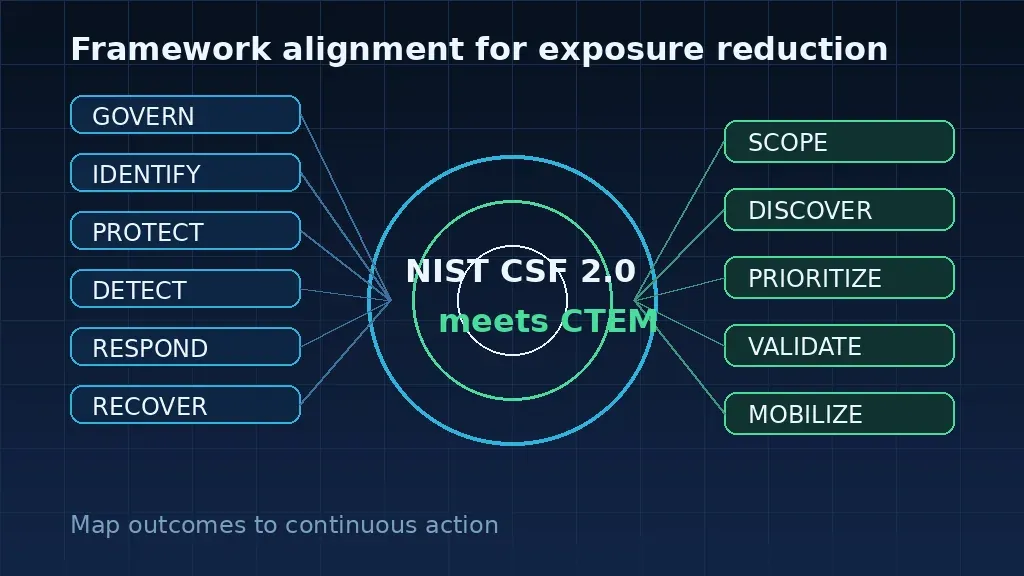
The NIST Cybersecurity Framework gives security leaders a common language for managing cyber risk, but it does not tell teams which exposed asset to fix first on Monday morning. Continuous Threat Exposure Management fills that execution gap. When the NIST cybersecurity framework and CTEM are aligned, the framework defines the outcomes, while CTEM supplies the continuous operating model that discovers exposures, ranks them by real risk, validates controls, and mobilizes remediation.
Ready to turn framework outcomes into measurable exposure reduction? Book a Uni5 Xposure demo to see how Hive Pro operationalizes CTEM across your security program.
This alignment matters because most organizations already use NIST CSF to communicate cyber risk with leadership, auditors, and business owners. At the same time, vulnerability management teams are under pressure to prove that their work reduces real exposure, not just ticket volume. NIST CSF 2.0 and CTEM are not competing approaches. NIST CSF provides the strategic risk management structure. CTEM provides the repeatable cycle that keeps that structure current, evidence based, and actionable.
What is the relationship between NIST CSF and CTEM?
NIST CSF 2.0 is a high-level cybersecurity risk management framework organized around six continuous functions: Govern, Identify, Protect, Detect, Respond, and Recover. NIST describes the framework as a taxonomy of outcomes that organizations can use to understand, assess, prioritize, and communicate cybersecurity efforts. It is intentionally flexible. It explains what good cybersecurity outcomes look like, but it does not prescribe one specific method for achieving them.
CTEM is the execution model that helps security teams make those outcomes operational. Gartner's CTEM cycle is commonly described through five stages: Scope, Discover, Prioritize, Validate, and Mobilize. Instead of treating vulnerability management as a periodic scan-and-patch workflow, CTEM creates a continuous loop that starts with business context and ends with verified risk reduction.
The simplest way to understand the relationship is this:
- NIST CSF defines the destination. It tells leadership which cybersecurity outcomes the organization should manage and improve.
- CTEM defines the operating rhythm. It tells security teams how to find, evaluate, validate, and remediate the exposures that affect those outcomes.
- Alignment connects governance to action. It gives CISOs a way to report progress in NIST language while directing teams through CTEM workflows.
That is why CTEM is especially useful for organizations that already have a NIST-based security program but still struggle with tool sprawl, vulnerability overload, slow remediation, or weak proof that fixes actually worked.
Why NIST CSF 2.0 needs an operational exposure management layer
NIST CSF 2.0 added more visible emphasis on governance, enterprise risk alignment, and continuous improvement. Those updates reflect how security programs are now judged. Boards do not only want to know whether scanners run. They want to know which cyber risks matter most, who owns them, how quickly they are being reduced, and whether controls are working.
Traditional vulnerability management often falls short because it produces raw findings faster than teams can act. Security teams may have millions of scanner results across cloud, code, containers, applications, infrastructure, and external assets. Sorting those findings by CVSS alone does not prove business risk reduction. It also does not show whether a control blocks an attack path, whether a vulnerability is reachable, or whether remediation was actually completed.
CTEM adds the missing operational layer by turning NIST outcomes into a continuous evidence loop. It helps teams answer practical questions that sit underneath the framework:
- Which business services and assets are in scope for exposure reduction?
- Where are the blind spots across known and unknown assets?
- Which vulnerabilities are actively exploitable or tied to relevant threat actor behavior?
- Do security controls detect or block the attack techniques that matter?
- Which teams own remediation, and are fixes completed within the expected timeline?
- Can leadership see measurable exposure reduction over time?
In other words, NIST CSF gives the program structure. CTEM makes that structure measurable.
NIST CSF functions mapped to CTEM stages
The most useful alignment is not a one-to-one checklist. NIST CSF functions are concurrent and continuous, and CTEM stages form an iterative cycle. Several CTEM stages support multiple NIST functions at once. The goal is to show how exposure management activities produce evidence for framework outcomes.
NIST CSF 2.0 functionPrimary CTEM supportWhat the alignment producesGovernScope, Prioritize, MobilizeRisk ownership, scope boundaries, business impact criteria, remediation accountability, and executive reporting.IdentifyScope, DiscoverAsset visibility, exposure inventories, attack surface context, and business service mapping.ProtectPrioritize, MobilizeRisk-based remediation plans, hardening actions, patch priorities, configuration fixes, and compensating control decisions.DetectDiscover, ValidateContinuous monitoring, exposure detection, control validation, and evidence that detection controls work against relevant techniques.RespondValidate, MobilizeConfirmed exposure impact, work items for response or remediation teams, escalation paths, and tracked mitigation activity.RecoverValidate, Mobilize, ScopeVerification that fixes restored the intended security posture, lessons learned, and updated scope for the next CTEM cycle.
This mapping helps security leaders avoid a common mistake: treating NIST CSF as a reporting framework only. When CTEM is mapped to each function, the framework becomes a live management system that reflects the current exposure state of the business.
How does each CTEM stage support NIST CSF?
Each CTEM stage creates a different type of evidence. Together, they help security teams show that NIST CSF outcomes are not just documented, but actively managed.
1. Scope supports Govern and Identify
Scoping defines what the CTEM program will protect, why those assets matter, and how success will be measured. This aligns directly with the Govern function because governance starts with risk ownership, priorities, policies, roles, and risk tolerance. It also supports Identify because teams cannot identify meaningful cybersecurity risk without knowing which business services, systems, users, and third parties are in scope.
A strong CTEM scope should not be a broad inventory dump. It should connect technical assets to business consequences. For example, a financial services organization might scope customer-facing applications, payment systems, privileged identity paths, cloud workloads, and externally exposed services that support critical operations. That scope helps leadership understand where exposure reduction matters most.
Useful evidence includes scope charters, asset ownership records, business criticality tags, risk appetite statements, crown-jewel asset lists, and service maps.
2. Discover supports Identify and Detect
Discovery creates continuous visibility across assets, vulnerabilities, misconfigurations, identities, cloud services, applications, containers, code, and external attack surface exposures. It supports Identify by revealing what exists and where risk may reside. It supports Detect because ongoing discovery helps teams notice new exposures, changed configurations, and asset drift before attackers exploit them.
This is where a unified platform becomes important. Many organizations have separate tools for vulnerability scanning, cloud posture, application security, external attack surface management, and asset inventory. CTEM requires those findings to be normalized into one exposure view so teams can see relationships instead of isolated alerts.
Hive Pro's Uni5 Xposure supports this stage by consolidating vulnerability data from multiple tools and legacy scanners into a unified platform. It also includes native scanners across code, container, cloud, web, network, and mobile environments, plus external attack surface management capabilities.
3. Prioritize supports Govern and Protect
Prioritization is where CTEM moves beyond severity scores. NIST CSF expects organizations to understand, assess, and prioritize cybersecurity risk. CTEM makes that practical by combining technical severity with exploitability, threat intelligence, asset criticality, reachability, control context, and business impact.
This stage is critical because it turns governance intent into protection decisions. If leadership says customer-facing systems and regulated data are high priority, the prioritization model should reflect that. If a vulnerability is attached to a non-critical isolated asset, it may not outrank a lower-CVSS exposure on an internet-facing crown-jewel system with active exploitation signals.
Hive Pro's Vulnerability and Threat Prioritization capability is designed for this problem. Uni5 Xposure uses context-aware prioritization informed by factors such as exploitability, threat actor activity, asset criticality, business context, and environmental conditions. The result is a remediation queue teams can defend to executives, auditors, and engineering owners.
4. Validate supports Detect, Respond, and Recover
Validation tests whether priority exposures are actually exploitable and whether security controls work as expected. This is the bridge between theoretical risk and real-world exposure. It supports Detect by checking whether controls generate the right signals. It supports Respond by confirming which exposures require action. It supports Recover by verifying that fixes actually removed the risk.
Validation is also where CTEM improves confidence in NIST CSF reporting. A dashboard that says a vulnerability was patched is not enough if the attack path still exists through another route. Validation helps prove whether the environment is safer after remediation.
Hive Pro supports validation through integrated security control validation, breach and attack simulation, attack path analysis, and closed-loop verification. These capabilities help teams test exposures against real attack techniques without waiting for an annual penetration test cycle.
Need stronger proof that your remediation program is reducing risk? Schedule a demo to see how Hive Pro validates exposures and controls inside a CTEM workflow.
5. Mobilize supports Protect, Respond, Recover, and Govern
Mobilization converts validated findings into action. This stage assigns owners, creates tickets, provides remediation guidance, tracks SLAs, manages exceptions, and reports results. It supports Protect because fixes are applied. It supports Respond because urgent exposure actions are routed to the right teams. It supports Recover because remediation is verified. It supports Govern because accountability and performance become measurable.
Mobilization is where many exposure programs fail. Security teams may identify the right issues, but remediation owners need clear context, specific steps, business justification, and workflow integration. Without that, high-risk findings sit in queues while new findings continue to pile up.
Uni5 Xposure helps mobilize remediation through workflow automation, ITSM integrations such as ServiceNow and Jira, remediation guidance, SLA tracking, and performance metrics. That makes CTEM more than a reporting exercise. It becomes a coordinated operating model for reducing exposure.
Building a NIST CSF and CTEM alignment model
Security leaders can use a simple five-step model to connect NIST CSF outcomes to CTEM operations.
Step 1: Define the NIST outcomes that matter most
Start with the NIST CSF functions and select the outcomes most relevant to the organization's risk profile. For some teams, the priority may be asset visibility and governance. For others, it may be remediation accountability, continuous monitoring, third-party risk, cloud exposure, or recovery planning.
Do not try to operationalize every outcome at once. Choose a manageable set tied to business impact. A focused first cycle is easier to measure and easier to improve.
Step 2: Translate outcomes into CTEM scope
Map each selected outcome to a CTEM scope. For example, if the NIST priority is better Identify coverage for internet-facing systems, the CTEM scope might include external attack surface management, public cloud assets, and customer-facing applications. If the NIST priority is stronger Protect outcomes for critical systems, the CTEM scope might include vulnerabilities affecting crown-jewel assets and privileged access paths.
Step 3: Connect tools and normalize exposure data
Bring scanner, asset, cloud, application, identity, threat intelligence, and control data into a shared exposure model. This step is essential because NIST reporting depends on consistent evidence. If every tool has its own severity, naming, asset owner, and status field, leaders cannot reliably measure progress.
A CTEM platform should reduce this fragmentation by normalizing findings and creating a single operational view across the attack surface.
Step 4: Prioritize by business risk and threat context
Create prioritization rules that reflect NIST governance decisions. Those rules should include business criticality, exploitability, known exploited vulnerabilities, threat actor targeting, asset exposure, control coverage, and remediation feasibility. This gives teams a defensible reason for what they fix now, what they defer, and what they accept as residual risk.
Step 5: Validate, mobilize, and report in NIST language
Use validation to prove whether exposures and controls behave as expected. Then mobilize remediation through tickets, owners, SLAs, and executive dashboards. Report results using language that maps back to NIST CSF functions: improved asset visibility for Identify, reduced exploitable exposure for Protect, validated controls for Detect, faster remediation for Respond, and verified restoration for Recover.
What evidence should security teams track?
The value of NIST CSF and CTEM alignment depends on evidence quality. Leaders, auditors, and remediation teams need more than a vulnerability count. They need proof that the program is reducing risk in a structured way.
Track evidence in five categories:
- Governance evidence: scope documents, risk ownership, risk acceptance decisions, policies, SLAs, exception approvals, and executive reporting.
- Visibility evidence: asset inventories, scanner coverage, external exposure records, cloud posture findings, identity exposure data, and data freshness metrics.
- Prioritization evidence: exploitability signals, threat intelligence, KEV and EPSS context, asset criticality, business impact, attack path relationships, and prioritization rationale.
- Validation evidence: breach and attack simulation results, control test outcomes, detection coverage, attack path validation, and post-fix verification.
- Mobilization evidence: tickets, owners, remediation steps, SLA performance, MTTR, exception status, and verified closure.
This evidence also improves communication. A CISO can report exposure reduction by business service rather than drowning leadership in raw vulnerability counts. Engineering teams can see why a ticket matters. Audit and compliance stakeholders can see how risk decisions were made and tracked.
Common pitfalls when aligning NIST CSF and CTEM
Alignment fails when organizations treat either framework as a document instead of an operating model. Watch for these common issues.
Using NIST CSF only for annual assessment
If NIST CSF is reviewed once a year and then shelved, it will not reflect the current threat landscape. CTEM keeps framework outcomes connected to real-time exposure data and remediation activity.
Treating CTEM as another scanner
CTEM is not simply more scanning. It is a cycle that includes scoping, discovery, prioritization, validation, and mobilization. If a program stops at discovery, it will increase alert volume without improving NIST outcomes.
Prioritizing only by CVSS
CVSS can be useful, but it does not show business impact, exploit activity, reachability, compensating controls, or attack path context by itself. CTEM prioritization should reflect the risk decisions made under the Govern function.
Skipping validation
Without validation, teams cannot prove whether controls work or whether remediation removed exposure. Validation is what turns a status update into defensible evidence.
Failing to mobilize remediation owners
Security teams do not reduce exposure alone. Application, infrastructure, cloud, identity, and IT operations teams need actionable tickets, clear ownership, and realistic SLAs. Mobilization is the difference between knowing about risk and reducing it.
How Hive Pro supports NIST CSF and CTEM alignment
Hive Pro's Uni5 Xposure platform is built to operationalize the full CTEM lifecycle in one platform. For organizations aligning CTEM with NIST CSF, that matters because the hardest part is not writing the mapping. The hardest part is keeping the evidence current while coordinating work across teams and tools.
Uni5 Xposure supports the alignment through:
- Total attack surface visibility: Native scanners and third-party integrations help identify assets and exposures across code, containers, cloud, web, network, mobile, and external attack surfaces.
- Unified exposure data: Findings from tools such as Tenable, Qualys, Rapid7, Snyk, Wiz, AWS Security Hub, Azure Security Center, and other systems can be consolidated into one operational view.
- Threat-informed prioritization: HiveForce Labs intelligence and contextual risk scoring help teams focus on exposures most likely to affect the business.
- Integrated validation: Breach and attack simulation, security control validation, and attack path analysis help confirm which risks are exploitable and whether controls are working.
- Remediation orchestration: Jira, ServiceNow, collaboration, reporting, SLA tracking, and guidance workflows help turn validated findings into completed action.
- Flexible deployment: Cloud, on-premises, and hybrid deployment models support different security, data residency, and operational requirements.
The result is a practical bridge between NIST CSF outcomes and daily exposure management work. Security leaders get a governance-ready view of risk. Security teams get a prioritized and validated workflow. Remediation owners get clearer direction.
FAQ: NIST cybersecurity framework CTEM alignment
Is CTEM a replacement for NIST CSF?
No. CTEM is not a replacement for NIST CSF. NIST CSF is a cybersecurity risk management framework that defines outcomes across Govern, Identify, Protect, Detect, Respond, and Recover. CTEM is an operating model for continuously reducing exposure through scoping, discovery, prioritization, validation, and mobilization. They work best together.
Which NIST CSF function maps most directly to CTEM?
Identify maps strongly to CTEM scoping and discovery, but CTEM supports all six NIST CSF 2.0 functions. Prioritization and mobilization support Govern and Protect. Validation supports Detect, Respond, and Recover. The strongest alignment treats both models as continuous cycles rather than static checklists.
How does CTEM improve NIST CSF reporting?
CTEM improves NIST CSF reporting by adding current exposure data, risk-based prioritization, validation results, remediation ownership, SLA performance, and proof of closure. This helps leaders report measurable risk reduction instead of relying on raw vulnerability counts or annual maturity statements.
Can CTEM help with audits and compliance?
Yes. CTEM can produce evidence that supports audit and compliance activities, including asset scope, continuous monitoring, risk-based prioritization, control validation, remediation tracking, exception handling, and closure verification. It does not replace compliance frameworks, but it can make evidence collection more operational and less manual.
What is the first step to align CTEM with NIST CSF?
Start by selecting a business-critical scope and mapping it to specific NIST outcomes. Then connect exposure data, prioritize by business risk and threat context, validate the most important findings, and mobilize remediation through owned workflows. A focused first cycle is more effective than trying to map everything at once.
Turn NIST outcomes into exposure reduction
NIST CSF and CTEM solve different parts of the same problem. NIST CSF gives organizations a common language for governing and communicating cybersecurity risk. CTEM gives security teams the continuous workflow needed to reduce the exposures behind that risk.
When aligned well, the result is a security program that can answer the questions leaders actually ask: What matters most? Why are we fixing this first? Did the control work? Did remediation reduce risk? What evidence proves it?
That is the value of aligning the NIST cybersecurity framework and CTEM. It moves security from framework compliance to operational confidence.
If your team is ready to operationalize NIST CSF outcomes through continuous exposure management, book a Uni5 Xposure demo and see how Hive Pro helps teams scope, discover, prioritize, validate, and mobilize risk reduction.







.svg)