 Critical Threat Research : The Iranian Cyber War Intensifies!


Comprehensive Threat Exposure Management Platform
CTEM coverage claims sound similar until teams compare how exposure evidence becomes action. A fair platform decision hinges on discovery, validation, intelligence, and the remediation model already in place.
Comparing CTEM platforms now? Book a Hive Pro demo to assess integrated discovery, validation, and threat-informed remediation against your requirements.
Zafran vs Hive Pro is a CTEM comparison between platforms that both address continuous exposure management, but through different operating emphases. According to its published CTEM description, Zafran aggregates and deduplicates existing tool data, applies context, and helps teams use current defenses for mitigation. Hive Pro positions Uni5 Xposure around aggregation plus native discovery, BAS validation, and HiveForce Labs threat intelligence in one workflow. It integrates six native scanners with an aggregation hub collecting data from more than 50 security tools, as Hive Pro states. The right choice depends on whether your team values remediation through existing controls, integrated discovery and validation, or a blend matched to present operations.
That makes the practical question clear: which operating model fits the exposures, tools, and validation work your team must manage now? The comparison begins with the most important differences in Zafran vs Hive Pro.
Zafran vs Hive Pro is not a choice between CTEM coverage and no CTEM coverage. According to Zafran, its platform supports the entire CTEM lifecycle, from scoping through mobilization. Hive Pro also addresses the lifecycle through its Uni5 Xposure platform. The useful question is how each team wants that work to run.
On its official CTEM framework page, Zafran describes a model that brings together asset and vulnerability data from existing security tools. It normalizes and deduplicates that data, then adds threat, defense, and business context. Its stated approach also uses existing controls for mitigation and supports remediation workflows.
Hive Pro’s Uni5 Xposure platform overview presents an integrated model. It combines native scanners, data aggregation, Breach and Attack Simulation (BAS), and HiveForce Labs threat intelligence. That distinction may matter when a team compares built-in discovery and validation with an existing-tool-led model.
| Evaluation lens | Zafran | Hive Pro |
|---|---|---|
| CTEM lifecycle claim. | States support from scoping to mobilization. | Positions Uni5 Xposure as full-lifecycle CTEM. |
| Data and discovery model. | Aggregates and normalizes existing tool data. | Combines native scanners with aggregation. |
| Exposure validation. | Uses defense context in analysis. | Includes BAS within the platform model. |
| Threat context. | Adds threat intelligence and business criticality. | Uses HiveForce Labs threat intelligence. |
| Remediation workflow. | Highlights mitigation through existing tools. | Connects discovery, validation, and remediation. |
Start with the program design, not a broad feature count. A team invested in security controls may value workflows built around those tools. A team seeking integrated scanning and BAS may weigh Hive Pro’s model differently.
For more context, review how Breach and Attack Simulation can support vulnerability management. Then map each platform to current tools, gaps in discovery, and the level of validation the program requires.
Also ask how findings become actions that owners can track. CISA’s CDM program emphasizes risk-based, consistent, and cost-effective cybersecurity solutions. In a platform review, check data sources, validation steps, control use, ticket flow, and reporting.
For a CISO, Zafran vs Hive Pro is not simply a contest between product labels. It is a choice about how exposure work is run each week. A CTEM operating model keeps findings tied to decisions, testing, and follow-through.
CISA describes a continuous diagnostics program that provides tools, integration services, and dashboards to help agencies reduce their threat surface. Its continuous diagnostics and mitigation model supports a key principle: exposure work needs an ongoing cycle, not a one-time review.
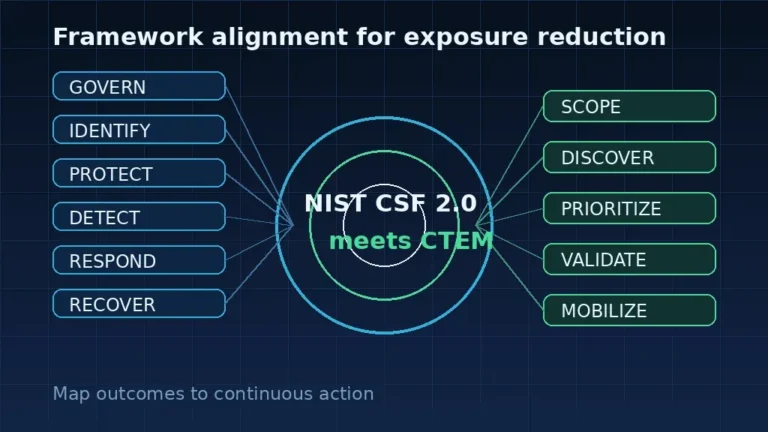
In a CTEM program, the team first defines which assets, paths, and business services are in scope. It then discovers exposures and sorts them by likely business harm. The team validates whether a risk can be used in practice, then mobilizes owners to act.
These five stages, scoping, discovering, prioritizing, validating, and mobilizing, must connect. Discovery without priority creates noise. Priority without validation can waste repair effort. Mobilization matters because accepted work must reach teams that can fix, contain, or track the exposure.
A product checklist may show scanners, connectors, dashboards, or control tests. It does not show whether teams can move from scope to action without manual gaps. In a CTEM platform comparison, ask how each platform supports that flow. Then assess how it works with current data and tools.
This focus avoids false equivalence. Two platforms may address exposure work, yet require different choices for discovery, validation, ownership, and handoff. A buyer should map those choices against staffing, existing controls, reporting needs, and risk governance.
Security leaders need more than a capability grid. NIST guidance on enterprise cyber risk describes cyber risk registers tied to an enterprise risk profile. It says this link helps teams prioritize and communicate response and monitoring. Governance is therefore part of platform evaluation.
For Zafran vs Hive Pro, evaluation should start with operating questions. What data enters each stage? How is validation handled? How do risk owners receive and track action? Answers reveal workflow fit without relying on unsupported performance promises.
Discovery is where a Zafran vs Hive Pro comparison becomes practical for security teams. Both approaches aim to make exposure data usable, but they begin with different sources of visibility.
Zafran’s published position describes an API-based approach that aggregates findings from existing security tools. It normalizes and de-duplicates records, then relates exposures to controls already in the environment.
Hive Pro’s documented position adds native discovery to aggregated inputs. Uni5 Xposure combines an aggregation hub with six native scanners. These span code, containers, cloud, web, network, and mobile surfaces.
This design connects discovery with a wider asset view. It is also reflected in Hive Pro’s cyber asset attack resources, which address risk in asset context.
The difference matters when a team asks where a finding first comes from. An aggregation-led model can bring existing results into a common view. A model with native scanning can also gather findings through built-in discovery paths.
Neither description alone proves fit for every environment. Buyers should test whether asset identity and ownership stay clear after records are merged. CISA’s Continuous Diagnostics and Mitigation program also links integrated cyber tools with reducing threat surface.
Start with coverage, not feature counts. Ask which asset types are found natively and which need connectors. Also ask which parts of the attack surface may remain unseen.
Teams mapping discovery to governance can review Hive Pro’s CTEM coverage discussion. Then use a trial or proof of concept to check:
Test a representative asset set before comparing dashboards. Review uncovered assets, duplicate handling, connector setup, and evidence export. The result shows whether discovery context supports day-to-day remediation choices.
Prioritization decides which exposures deserve action first. Validation checks whether a risk is reachable, exploitable, or already limited by a working control. They are linked steps, but they answer different questions for security teams.
A long vulnerability queue cannot show business impact by itself. Teams need threat context and asset importance before assigning scarce remediation time. NIST notes that likelihood and impact in risk registers help teams prioritize and communicate cyber risk response.
On its official CTEM page, Zafran describes contextual analysis for prioritization. Its stated inputs include threat intelligence, compensating controls, and business criticality. Zafran also describes control analysis, which can inform how a team views exposure risk.
Hive Pro describes prioritization as a way to sort exposures using risk and active threat context. Its vulnerability threat prioritization approach matters when teams need a ranked repair queue. In a Zafran vs Hive Pro review, buyers can compare inputs, outputs, and proof for each workflow.
Validation serves a different purpose from ranking. A high-priority finding may still require evidence of attack paths and control performance. That evidence can help teams decide whether to patch, adjust a control, or inspect the asset further.
Hive Pro presents native BAS as part of its validation capability. BAS can run attack simulations to test whether security controls detect or stop selected techniques. Teams reviewing security control validation should ask what is tested, what evidence is saved, and how results guide repair work.
This distinction keeps the comparison precise. Prioritization helps teams choose where to act first; validation tests whether defensive measures affect that risk. A platform review should check both the ranking logic and the evidence produced after testing.
Threat intelligence changes remediation when it shows which exposures connect to active adversary behavior, reachable assets, or business harm. A scanner can flag a weakness; threat context helps teams decide what needs action first.
The shift is practical. A team may have many valid findings, but it still needs an order for patches, control changes, testing, and messages to business owners. Context gives analysts a reason for moving one task ahead of another.
For leaders, that choice must be clear and defensible. NIST notes that documenting likelihood and impact in cyber risk registers helps teams prioritize and communicate risk response. The queue can then connect exposure evidence with risk owners, response choices, and follow-up.
In a Zafran vs Hive Pro review, this is a practical dividing line. Zafran’s official positioning centers on remediating risk through existing controls. Buyers should check how that model uses threat context, routes work, and explains each choice to stakeholders.
Existing controls may give a team a near-term response path while a lasting fix is planned. The key review point is not the label on that path. It is whether the platform shows why the selected response fits the current threat and exposed asset.
Hive Pro presents HiveForce Labs as its threat intelligence differentiator within a broader platform approach. Teams can review its intelligence sources, update process, and link to remediation workflows. They can then decide whether that approach fits their program.
Threat context is useful only when it changes action. During evaluation, ask each vendor to trace one exposed asset from discovery through priority, control choice, validation, and executive reporting.
Those questions keep a CTEM coverage discussion tied to decisions, not feature counts. Threat intelligence should sharpen remediation order and communication; it should not replace documented risk judgment.
A Zafran vs Hive Pro shortlist should start with operating needs, not product claims. Some teams need to make existing security data easier to act on. Others also need new discovery or safe testing workflows inside the same program.
Set the test team before the trial starts. Include vulnerability operations, security validation, asset owners, risk governance, and one remediation owner from IT or engineering.
This approach treats exposure work as a continuing practice. CISA’s Continuous Diagnostics and Mitigation program uses tools, integration services, and dashboards. They help agencies reduce their threat surface.
Use a time-boxed proof of value with real sample data and clear success checks. The result should show which approach fits the team’s current gaps and delivery model.
Map existing data sources. List scanners, cloud findings, endpoint controls, ticketing systems, asset records, and threat inputs. Record ownership, refresh rates, duplicate records, and integration limits before a vendor demo.
Define discovery gaps. Mark assets or exposure types that remain hard to see today. A team with broad scanner coverage may value data unification. A team with blind spots should test whether new discovery is required.
Require prioritization evidence. Give both options a representative set of findings. Ask each vendor to explain risk signals, deduplication, threat context, and why one item should be fixed first.
Test validation and remediation handoffs. Follow selected findings through validation, assignment, exception handling, and closure. Include a failed test and a reopened finding, so the workflow faces normal friction. Confirm whether evidence reaches the owners who can act, without manual rework.
Measure governance fit. Set review cadence, reporting fields, approval rules, and risk acceptance needs. A platform must fit risk review, audit evidence, and accountable ownership. Use the CTEM business case to connect operating fit to budget and executive decisions.
Score each test against coverage, actionability, handoff effort, reporting, and control ownership. Record gaps as shortlist conditions, not as assumptions to settle after purchase.
Security teams with strong third-party discovery may shortlist the option that proves the cleanest prioritization and handoffs. Teams seeking broader in-platform coverage should test discovery and validation depth in the same way.
Do not decide from a capability checklist alone. Keep the same test set, success measures, and governance questions for both providers. The stronger shortlist result is the one your team can verify and operate.
A proof of value should test outcomes, not feature lists. For a Zafran vs Hive Pro review, ask each vendor to prove how its platform finds exposure and tests risk. Ask how it routes action as well. This goal fits the CISA CDM focus on reducing threat surface through tools, integration services, and dashboards.
Begin with the exposures your current tools may miss. Supply a defined asset group, such as cloud workloads, web apps, or endpoints. Then ask the vendor to show what it finds. Ask what data supports each finding and which gaps remain outside scope.
Validation should yield evidence that a security team can review, not only a risk score. Ask for the test method, affected asset, control context, and result. If attack simulation is in scope, define safe limits before testing begins.
A proof of value should follow one issue from discovery to closure. Ask who owns triage, ticket creation, exception approval, fix checks, and reporting. Request a live handoff into the systems your teams use. Fields should map clearly, with no hidden manual entry.
For a broader benchmark, use Hive Pro’s CTEM platform comparison to frame the same workflow questions across vendors. A consistent scorecard lets leaders compare evidence, ownership, and effort. It also reduces reliance on a polished demonstration.
End the proof of value with an executive review. Ask for a report that links open exposure to business assets, validation status, owner, and next action. Leaders should see what changed, what remains unknown, and which assumptions still need proof.
Set those criteria before the demonstration. This step keeps a comparison grounded in proof, working integrations, and accountable remediation. It also helps teams reject claims that are hard to check later.
Zafran and Hive Pro both address CTEM, but they present different operating models. According to Zafran, its platform emphasizes aggregating and normalizing existing tool data, then using defenses and workflows for mitigation. Hive Pro describes Uni5 Xposure as combining aggregation with six native scanners, BAS, and threat intelligence. Security teams should compare integrations, discovery needs, validation methods, and remediation workflows.
Both vendors describe coverage across a CTEM lifecycle. Zafran describes workflows built around existing security tool data, contextual prioritization, and mitigation through existing controls. Hive Pro’s Uni5 Xposure platform integrates aggregation, six native scanners, BAS, and threat intelligence into one platform. A comparison should test required asset types, validation workflows, control integrations, and remediation ownership.
Yes. Hive Pro states that Uni5 Xposure includes Breach and Attack Simulation, or BAS. It also identifies six native scanners for code, containers, cloud, web, network, and mobile assets. The Hive Pro platform description identifies aggregation from more than 50 security tools. Buyers should verify scan types, integrations, test safeguards, and reporting workflows for their environment during evaluation.
Compare evidence from a controlled evaluation, not a vendor promise. Establish baseline exposures, critical assets, remediation time, validation results, and analyst effort before deployment. Use the same scope and reporting period for each platform. The NIST guidance on cybersecurity risk registers supports documenting likelihood and impact to prioritize and communicate risk response. Favor results your team can repeat and audit.
A delayed platform decision can leave security teams managing exposure priorities through disconnected processes and uncertain validation steps. Each review cycle spent waiting may postpone a better-defined CTEM workflow and clearer accountability for acting on priority findings. Starting now gives your team time to compare platform fit before operational gaps create more work across the program.
Ready to compare approaches against your security workflow and decision criteria? Book a demo with Hive Pro to evaluate Hive Pro for your CTEM program. Discuss how integrated discovery, BAS, and threat intelligence fit your scope, validation needs, and next planning cycle. Bring your current requirements, data sources, and validation priorities so the conversation focuses on practical coverage and implementation questions.