 Critical Threat Research : The Iranian Cyber War Intensifies!


Comprehensive Threat Exposure Management Platform
Your organization’s security is only as strong as its weakest vendor. A single compromised supplier, an unpatched software dependency, or a breached managed service provider can give attackers a direct path into your environment, bypassing every control you have built internally. The SolarWinds attack proved this at scale. So did Kaseya. And the MOVEit breach. Each time, the entry point was not the target organization itself but a trusted third party in the supply chain.
See how Uni5 Xposure maps and prioritizes supply chain exposures. Book a demo.
Supply chain cybersecurity risk management has moved from a niche concern to a board-level priority. According to Gartner, by 2025, 45% of organizations worldwide will have experienced attacks on their software supply chains, a three-fold increase from 2021. For CISOs and security leaders, managing these risks requires a fundamentally different approach than securing your own perimeter. You are not just protecting what you control; you are managing risk across an ecosystem of vendors, partners, and service providers that you cannot directly audit or patch.
This guide breaks down what supply chain cybersecurity risk management is, why it has become critical, the most common attack vectors, and a practical framework for building a program that actually reduces your exposure.
Supply chain cybersecurity risk management is the process of identifying, assessing, mitigating, and monitoring cyber risks that originate from third-party vendors, suppliers, software providers, and service partners. It covers every external entity that has access to your systems, data, or network, whether through direct integrations, software dependencies, or service-level agreements.
Unlike internal cybersecurity risk assessment, which focuses on your own infrastructure and controls, supply chain risk management extends your security posture outward. It requires visibility into how your vendors handle their own security, what access they have to your environment, and how their vulnerabilities could become your problem.
The scope typically includes:
Several converging factors have made supply chain cybersecurity risk one of the fastest-growing threat categories for enterprises.
Expanding attack surfaces. The average enterprise now relies on 250 or more third-party vendors with some form of network or data access. Each vendor represents a potential entry point. As organizations adopt more SaaS tools, cloud services, and API integrations, the number of external connections grows, and so does the attack surface.
Cascading impact. Supply chain attacks are efficient for adversaries because a single compromised vendor can provide access to hundreds or thousands of downstream targets simultaneously. The SolarWinds breach affected over 18,000 organizations through one poisoned software update. Attackers increasingly target the supply chain because the return on investment is far higher than attacking individual organizations one at a time.
Limited visibility. Most security teams have strong visibility into their own environment but minimal insight into vendor security practices. Traditional vendor risk assessments based on questionnaires and point-in-time audits provide a static snapshot that goes stale within weeks. Without continuous monitoring of cyber threats, you are making risk decisions based on outdated information.
Regulatory pressure. Governments and regulators have responded to the supply chain threat with new requirements. The U.S. Executive Order 14028 on Improving the Nation’s Cybersecurity mandates software supply chain security for federal contractors. The EU’s NIS2 Directive requires organizations to address supply chain risks. DORA (Digital Operational Resilience Act) imposes strict third-party risk management requirements on financial institutions. Compliance is no longer optional.
Software dependency complexity. Modern applications rely on hundreds of open-source components, each with its own dependencies. A vulnerability in a single widely used library, like Log4j in 2021, can expose millions of applications across every industry. Most organizations do not have a complete inventory of their software dependencies, making it impossible to respond quickly when a critical vulnerability surfaces.
Understanding how supply chain attacks happen is the first step toward defending against them. Here are the most common vectors security teams need to account for.
Attackers infiltrate a vendor’s build or distribution pipeline and inject malicious code into legitimate software updates. Because the update comes from a trusted source and carries a valid digital signature, it bypasses most security controls. SolarWinds (Orion update), Kaseya (VSA update), and the 3CX desktop client compromise all followed this pattern.
Vendors with VPN access, remote management tools, or API credentials become targets specifically because of the access they hold. The Target breach in 2013 started with stolen credentials from an HVAC vendor. Attackers compromised the vendor’s network, then used their legitimate access to pivot into Target’s payment processing systems.
Malicious packages published to public repositories (npm, PyPI, Maven) with names similar to popular libraries (typosquatting), or legitimate maintainers whose accounts are compromised, inject malicious code into projects that depend on those packages. The event-stream incident and the more recent xz Utils backdoor demonstrated how a single compromised open-source package can affect downstream consumers at scale.
MSPs manage IT infrastructure for multiple clients. A breach of the MSP gives attackers a single point of entry to every client environment they manage. Threat actors like APT10 (Cloud Hopper) specifically targeted MSPs to gain access to their clients’ networks.
While less common, hardware supply chain attacks involve modifying physical devices or firmware during manufacturing or shipping. This can include implanting backdoors in network equipment, compromising firmware updates, or substituting counterfeit components with embedded vulnerabilities.
An effective supply chain security program goes beyond questionnaires and annual audits. Here is a six-step approach that aligns with NIST and ISO best practices while accounting for real-world operational constraints.
You cannot manage risk you cannot see. Start by building a complete inventory of every vendor, supplier, and service provider that interacts with your systems or data. For each, document:
Most organizations discover they have 30-50% more third-party connections than they initially estimated. Cyber asset attack surface management tools help maintain a continuously updated view of external connections and the risk they introduce.
Not every vendor carries the same level of risk. A marketing analytics tool with read-only access to anonymized web data is fundamentally different from a cloud hosting provider that stores your production databases. Establish tiers based on:
Apply your most rigorous assessment and monitoring to Tier 1 vendors. Tier 3 vendors may require only standard contractual controls. This tiering prevents resource waste on low-risk relationships while ensuring critical vendors receive appropriate scrutiny.
Move beyond checkbox questionnaires. For Tier 1 and Tier 2 vendors, combine multiple assessment methods:
The goal is a risk-based approach to vulnerability management that treats vendor risk the same way you treat internal risk, with ongoing assessment rather than a snapshot taken once per year.
Contracts are your primary enforcement mechanism for supply chain security. At minimum, include:
Point-in-time assessments are necessary but not sufficient. Between assessments, vendor risk changes constantly as new vulnerabilities are disclosed, staff turns over, and threat actors shift tactics. Implement continuous monitoring that includes:
Organizations practicing continuous threat exposure management integrate supply chain risk signals into their broader exposure management workflow, ensuring vendor vulnerabilities are prioritized alongside internal findings based on actual exploitability and business impact.
Despite every precaution, supply chain breaches will happen. Your incident response plan should include supply chain-specific scenarios:
Breach and attack simulation tools help validate that your controls detect supply chain attack techniques before a real incident occurs, providing evidence-based confidence in your defenses rather than theoretical assumptions.
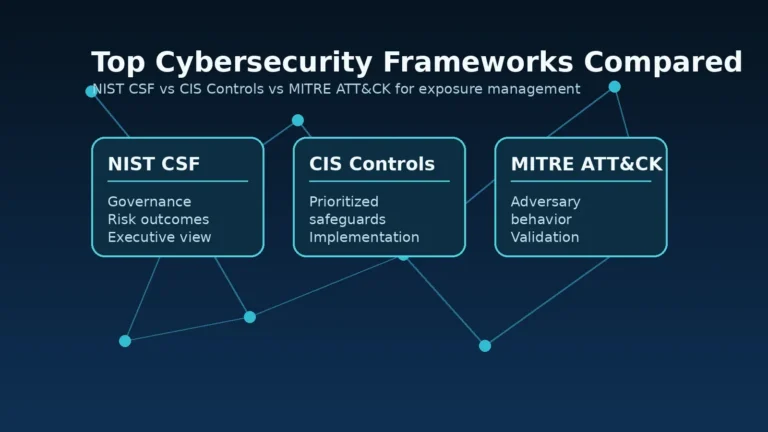
Several established frameworks provide structured guidance for supply chain cybersecurity risk management. Choosing the right framework depends on your industry, regulatory requirements, and organizational maturity.
| Framework | Focus Area | Best For |
|---|---|---|
| NIST SP 800-161r1 | Cybersecurity supply chain risk management for federal systems | Government contractors, organizations aligning to NIST CSF |
| NIST Cybersecurity Framework 2.0 | Added “Govern” function with explicit supply chain risk management category | Any organization building or maturing a security program |
| ISO 27036 | Information security for supplier relationships (4 parts) | Organizations with ISO 27001 certification pursuing supply chain controls |
| SLSA (Supply Chain Levels for Software Artifacts) | Software build integrity and provenance | Development teams securing CI/CD pipelines and software builds |
| SSDF (NIST SP 800-218) | Secure software development practices | Software vendors and development organizations |
| CIS Supply Chain Security Guide | Practical controls for supply chain defense | Organizations wanting actionable, prescriptive guidance |
NIST SP 800-161r1, updated in 2022, is the most detailed reference specifically for supply chain cybersecurity. It maps supply chain risk management practices to the NIST Cybersecurity Framework and provides implementation guidance across three organizational levels: governance, mission/business process, and operational. For most enterprises, starting with NIST CSF 2.0’s supply chain risk management category and then layering in 800-161 for deeper implementation guidance is a practical approach.
Traditional supply chain risk management relies on periodic assessments, annual questionnaires, and vendor scorecards. The problem is that these approaches create blind spots between assessment cycles. A vendor could be compromised, a critical dependency could have a zero-day vulnerability disclosed, or a new threat actor could begin targeting your industry’s supply chain, and you would not know until the next scheduled review.
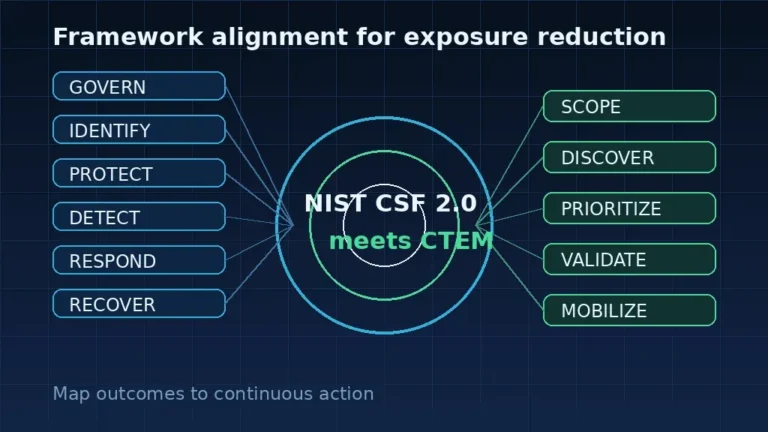
Continuous threat exposure management (CTEM) addresses this gap by bringing supply chain risk into a continuous loop of scoping, discovery, prioritization, validation, and mobilization. Instead of treating vendor risk as a separate program, CTEM integrates supply chain exposures into the same prioritized view as internal vulnerabilities.
Here is what that looks like in practice:
This approach moves supply chain risk management from a periodic compliance exercise to an operational security capability that responds to threats in real time.
Compromised software updates and third-party access exploitation are the highest-impact supply chain risks. Software supply chain attacks are particularly dangerous because malicious code arrives through trusted update channels with valid signatures, bypassing most security controls. The SolarWinds and Kaseya incidents demonstrated how a single compromised vendor can affect thousands of organizations simultaneously.
Critical (Tier 1) vendors should be assessed annually at minimum, with continuous monitoring between formal assessments. Tier 2 vendors warrant assessment every 12-18 months. Tier 3 vendors can be assessed every 2 years or upon contract renewal. Any vendor that experiences a reported breach or significant security incident should trigger an immediate reassessment regardless of schedule.
NIST SP 800-161r1 is the most detailed framework specifically for supply chain cybersecurity risk management. NIST CSF 2.0 includes a dedicated supply chain risk management category. ISO 27036 covers information security for supplier relationships. For software supply chain specifically, SLSA and NIST SP 800-218 (SSDF) provide build integrity and secure development guidance.
Start with a software bill of materials (SBOM) for every application, cataloging all open-source and third-party components. Implement software composition analysis (SCA) to continuously track vulnerabilities in those components. Verify software integrity through signed builds and provenance checks. Adopt the SLSA framework to incrementally strengthen your build pipeline security. And monitor threat intelligence for emerging vulnerabilities affecting your software dependencies.
Third-party risk management (TPRM) is broader, covering financial, operational, compliance, and reputational risks from any third party. Supply chain cybersecurity risk management focuses specifically on cyber threats that originate from or propagate through your supply chain. In practice, supply chain cyber risk is a subset of TPRM, concentrated on technical vulnerabilities, access risks, and software integrity across your vendor and supplier ecosystem.
Supply chain cybersecurity risk management is not a problem you solve once. It is an ongoing operational discipline that requires the same continuous attention you give to your internal security program. The organizations that manage supply chain risk most effectively treat it as a core component of their overall cyber threat exposure management strategy, not a separate compliance exercise run by procurement.
The practical steps are clear: build a complete vendor inventory, tier your third parties by risk, move beyond questionnaires to evidence-based and continuous assessment, and integrate supply chain threat signals into your vulnerability management workflow. The goal is not to eliminate all supply chain risk, which is impossible in a connected world, but to reduce your exposure to a level that matches your organization’s risk tolerance and to detect and respond to supply chain compromises before they become full-scale breaches.