CTEM Business Case: CISO Guide to ROI

CTEM Business Case: CISO Guide to ROI
A strong CTEM business case has to do more than explain why Continuous Threat Exposure Management matters. It has to show how a CTEM program reduces measurable business risk, improves remediation speed, consolidates security spend, and gives the board a clearer view of cyber exposure. For CISOs, the winning argument is not "we need another security tool." It is "we can reduce exploitable exposure faster, with fewer manual cycles, and prove the financial impact in terms the business already understands."
Book a Uni5 Xposure demo to see how Hive Pro helps security leaders quantify CTEM ROI with exposure reduction, validation, and remediation metrics.
The shift is important because many vulnerability programs still measure activity instead of outcomes. They count findings, patch tickets, and scan frequency, but struggle to answer the questions executives actually ask: Which exposures can hurt the business? Which fixes matter first? How much risk did we reduce this quarter? How much time and cost did the program save?
CTEM gives CISOs a practical structure for that conversation. It connects the five stages of exposure management, scope, discover, prioritize, validate, and mobilize, to financial and operational outcomes. When those outcomes are framed correctly, the business case becomes easier to defend.
Executive summary: what a CTEM business case must prove
A board-ready CTEM business case should prove four things:
- Risk reduction: The organization can find and reduce the exposures most likely to be exploited against critical assets.
- Operational efficiency: Security and IT teams can cut manual triage, duplicate findings, and remediation delays.
- Cost optimization: The company can reduce redundant tooling and avoid waste from low-value remediation work.
- Measurable governance: Leadership can track exposure trends, remediation accountability, and residual risk over time.
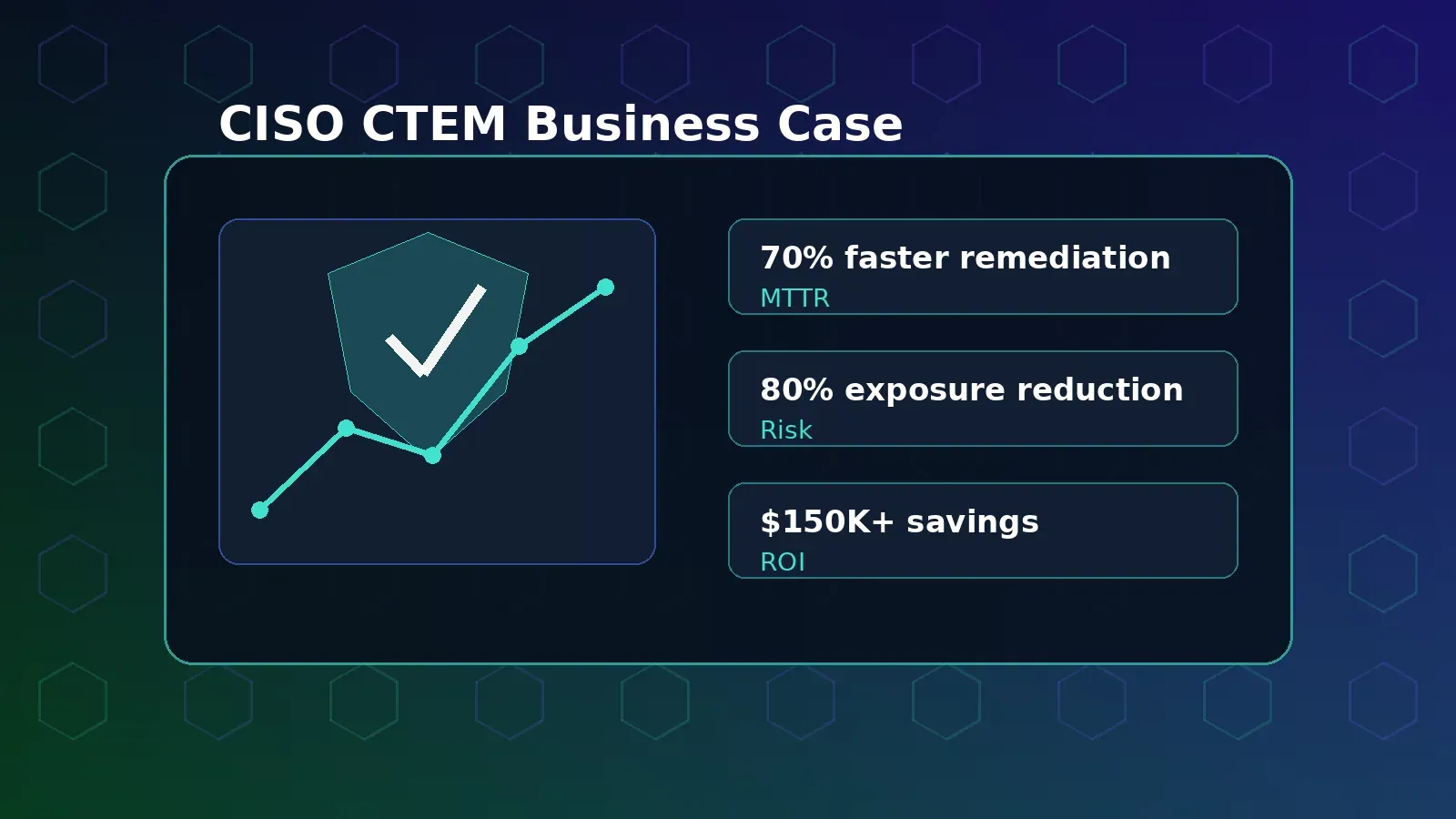
For Hive Pro customers, the ROI narrative often starts with four practical benchmarks: up to 70% reduction in remediation time, 80% reduction in threat exposure, $150,000 or more in annual savings from consolidation and efficiency gains, and 5X improvement in security team productivity. These are not vanity metrics. They map directly to the concerns CISOs hear from the board, the CFO, IT leadership, and audit teams.
A useful CTEM business case should also clarify what CTEM is not. CTEM is not simply a larger vulnerability scanner, a dashboard refresh, or another compliance report. It is an operating model that continuously connects asset visibility, threat intelligence, exploit validation, and remediation execution. Platforms such as Uni5 Xposure help operationalize that model by unifying exposure assessment, adversarial exposure validation, prioritization, and mobilization in one workflow.
Why CISOs need a different business case for CTEM
Traditional vulnerability management business cases usually center on coverage: more scans, more assets, more findings, and more reporting. That was useful when the main challenge was basic visibility. It is less useful when the organization already has multiple scanners, ticketing workflows, cloud tools, application security tools, and threat feeds, but still cannot consistently identify which exposures create the highest business risk.
The CISO's problem has changed. The question is no longer "Can we find vulnerabilities?" Most enterprise teams can. The harder questions are:
- Which exposures are reachable by attackers?
- Which vulnerabilities affect business-critical assets?
- Which findings are actively exploited in the wild?
- Which controls reduce risk if patching is delayed?
- Which remediation actions will produce the biggest reduction in exposure?
This is where Continuous Threat Exposure Management becomes a business conversation. CTEM helps CISOs move from activity-based reporting to outcome-based risk management. Instead of showing a board 40 pages of vulnerability counts, the CISO can show which attack paths were validated, which exposures were closed, how remediation time changed, and how residual exposure is trending.
The business case should make that transition explicit. If the current program creates long lists of findings but still leaves teams arguing over priority, CTEM is positioned as a way to focus scarce remediation capacity on the exposures that matter most.
Start with the business problem, not the platform
The most persuasive CTEM business cases start with a clear pain statement. Avoid opening with product capabilities. Start with the gap between current security operations and business expectations.
For many CISOs, the current-state problem looks like this:
- The organization has too many tools producing overlapping vulnerability data.
- Security teams spend too much time correlating, deduplicating, and explaining findings.
- IT teams receive tickets without enough business context to prioritize action.
- Critical remediation can take weeks because ownership, exploitability, and impact are unclear.
- Board reporting focuses on volume metrics instead of risk reduction.
Then connect those issues to business consequences: higher exposure windows, inefficient use of security talent, delayed patching for critical assets, audit friction, and difficulty defending budget requests.
Only after the business problem is clear should the case introduce CTEM as the operating model that closes the gap. A simple framing works well: "Our current program finds too much and fixes too slowly. CTEM helps us continuously identify, validate, prioritize, and mobilize against the exposures most likely to create business impact."
Translate CTEM outcomes into ROI metrics
A CTEM ROI model should not depend on vague claims about better security. It should connect program improvements to measurable financial and operational results. The following categories are the foundation of a defensible model.
1. Remediation time reduction
Mean time to remediate is one of the easiest CTEM metrics to translate into business value. Long remediation cycles extend the window of exposure and increase the likelihood that a known weakness becomes an incident. If critical findings currently take three weeks to resolve, reducing that cycle to days changes the organization's risk posture in a concrete way.
Hive Pro positions a 70% reduction in remediation time as a key CTEM value driver. For a CISO, that metric can be converted into a board-level message: "We are reducing the amount of time critical exposures remain open." For the CFO, it becomes an efficiency message: "We are reducing the manual coordination cost required to move from finding to fixing."
2. Exposure reduction
Exposure reduction measures whether the organization is actually lowering the number of exploitable paths to critical assets. This matters because patch counts alone can be misleading. A team might close hundreds of low-risk tickets while leaving a smaller number of exploitable, business-critical paths unresolved.
A CTEM program should prioritize exposures using business context, exploit activity, threat intelligence, and validation. Hive Pro's vulnerability and threat prioritization capabilities are designed to move teams beyond static CVSS-style scoring and toward context-aware risk reduction.
When building the ROI model, use exposure reduction as the primary risk metric. The target is not "patch everything." The target is "reduce the exposures most likely to be used in a real attack."
3. Productivity improvement
Security productivity is often hidden in the budget because it appears as analyst time, engineering effort, meeting cycles, and ticket backlogs. CTEM can improve productivity by consolidating data, reducing duplicate findings, automating prioritization, and giving remediation owners clearer instructions.
A 5X productivity improvement is especially compelling when the security team is understaffed. Instead of asking the board for budget only to add people, the CISO can show how CTEM helps existing teams focus on higher-value work. The productivity argument is not that people become less important. It is that skilled people spend less time manually reconciling scanner output and more time reducing real exposure.
4. Tool consolidation savings
Tool sprawl is one of the cleanest places to show hard-dollar ROI. Many enterprise security programs maintain overlapping scanners, prioritization tools, reporting systems, and manual workflows. Consolidating redundant capabilities can lower licensing costs, reduce administrative overhead, and simplify procurement.
Hive Pro's CTEM model combines native scanning, third-party aggregation, threat intelligence, prioritization, validation, and mobilization. With code-to-cloud scanning, asset and attack surface visibility, and 50+ integrations, the platform can support both consolidation and coexistence with existing security investments.
The business case should estimate annual savings from tools that could be retired, reduced, or avoided. Use conservative assumptions. A credible $150,000 savings case is stronger than an inflated number the CFO can easily challenge.
Start a free Uni5 Xposure trial to evaluate how CTEM can consolidate exposure data, prioritize risk, and accelerate remediation in your environment.
Build the financial model in five steps
The best CTEM business case is simple enough for executives to understand and detailed enough for finance to validate. Use the following five-step model.
Step 1: Establish the baseline
Document current-state metrics before proposing investment. Useful baselines include:
- Average time to remediate critical exposures.
- Number of critical and high findings open beyond SLA.
- Number of scanners and exposure-related tools in use.
- Analyst hours spent on manual correlation and prioritization.
- IT hours spent clarifying ownership, impact, and remediation steps.
- Volume of duplicate, stale, or low-context tickets.
- Board reporting time required each quarter.
If some data is unavailable, state the assumption and use a conservative estimate. A transparent model builds trust. A perfect model is less important than a model the business can inspect and refine.
Step 2: Quantify the avoidable cost
Translate the baseline into cost categories. Examples include software spend, analyst time, engineering time, delayed remediation exposure, and audit preparation. For labor calculations, multiply the estimated hours spent on manual work by loaded hourly cost. For tool consolidation, use contract values and administrative cost estimates.
The goal is not to claim every avoided cost as immediate savings. Some benefits show up as hard savings, such as retired licenses. Others show up as capacity returned to the business, such as analyst time redirected from spreadsheet work to threat analysis. Separate these categories so the CFO can see what is budget impact and what is productivity impact.
Step 3: Map CTEM capabilities to measurable outcomes
Do not list features without tying them to outcomes. The table below can be adapted for an internal business case.
CTEM capabilityBusiness outcomeMetric to trackUnified asset and exposure visibilityFewer blind spots across hybrid environmentsUnknown assets discovered, coverage by business unitThreat-informed prioritizationTeams focus on exploitable risk, not raw severityPercent of critical effort aligned to validated exposuresAdversarial exposure validationReduced wasted remediation on theoretical riskValidated attack paths closedRemediation mobilizationFaster handoff from security to ITMTTR, SLA adherence, reopened ticketsExecutive reportingClearer governance and budget accountabilityExposure trend, residual risk, cost avoided
Step 4: Calculate conservative ROI
A simple ROI structure works well:
- Annual benefit: tool savings + labor efficiency + avoided external services + measurable productivity gain.
- Annual cost: platform subscription + implementation + internal change management.
- Net benefit: annual benefit minus annual cost.
- Payback period: implementation cost divided by monthly net benefit.
Keep risk reduction in the model, but avoid pretending that every incident avoided can be precisely proven. Instead, show risk reduction alongside hard-dollar savings. For example: "$150,000 in tool and efficiency savings, 70% faster remediation, and 80% reduction in validated exposure." That combination is more credible than a single exaggerated loss-avoidance number.
Step 5: Define success milestones
Executives want to know when value will appear. Structure the first year into milestones:
- First 30 days: connect priority scanners, map critical assets, and establish exposure baseline.
- Days 31 to 60: validate top exposure paths, refine prioritization, and integrate remediation workflows.
- Days 61 to 90: report first measurable MTTR improvement, exposure reduction, and team productivity gains.
- Quarter 2 and beyond: expand scope, retire redundant workflows, and mature board reporting.
This phased plan makes the investment feel manageable. It also gives the CISO a way to show early wins before the program reaches full maturity.
How to present CTEM to the board
Board members do not need a technical walkthrough of every scanner, integration, or exploit chain. They need a concise explanation of why the current risk management model is insufficient and how CTEM improves governance.
A strong board narrative can follow this structure:
- Risk context: The attack surface is expanding across cloud, applications, identities, and third parties.
- Current gap: Existing tools generate findings, but they do not consistently identify the exposures most likely to create business impact.
- CTEM approach: We will continuously scope, discover, prioritize, validate, and mobilize against the highest-risk exposures.
- Expected impact: Faster remediation, lower exposure, better use of security resources, and clearer board reporting.
- Governance: Leadership will receive trend-based metrics that show residual exposure, SLA performance, and risk reduction over time.
This mirrors the guidance in Hive Pro's resources on presenting cybersecurity ROI to the board and CISO board reporting metrics. The message should be direct: CTEM is an investment in measurable exposure reduction, not another dashboard.
Address the questions finance, IT, and risk teams will ask
A CTEM business case usually touches multiple stakeholders. Anticipate their questions before the approval meeting.
Finance: what will this save?
Finance will look for hard savings, cost avoidance, and payback timing. Be ready with license consolidation opportunities, manual effort reduction, implementation cost, and renewal timing. Separate confirmed savings from projected productivity gains so the model does not look inflated.
IT operations: will this create more tickets?
IT teams may worry that CTEM will increase workload. The business case should explain that CTEM is designed to improve ticket quality, not simply increase ticket volume. Better prioritization, validation, ownership context, and remediation guidance should reduce noise and make work more actionable.
Risk and compliance: how does this support governance?
Risk teams care about repeatability and evidence. CTEM supports governance by creating a continuous record of exposure, prioritization logic, remediation actions, and trend reporting. This helps the organization demonstrate that it is managing risk systematically rather than reacting to scan results.
Security engineering: will this replace existing tools?
The answer does not have to be yes or no. In many environments, CTEM starts by integrating existing tools, normalizing their data, and adding validation and prioritization. Over time, redundant tools may be consolidated where the business case supports it. That balance reduces change risk.
Include validation, not just prioritization
One of the strongest CTEM business case arguments is validation. Prioritization tells teams what looks important. Validation helps prove what is exploitable or reachable in the context of the organization's environment. That distinction matters when remediation capacity is limited.
Breach and Attack Simulation can strengthen CTEM by testing whether exposures can be used in realistic attack paths. Hive Pro's guidance on the benefits of BAS in vulnerability management explains why validation improves prioritization, reduces wasted effort, and helps teams focus on exploitable risk.
For the business case, validation supports two financial arguments. First, it reduces wasted remediation on issues that are severe in theory but not exploitable in context. Second, it reduces the chance that teams miss chained exposures that create real attack paths to critical assets.
Sample CTEM business case one-page structure
CISOs can use the following structure as a one-page executive summary.
SectionWhat to includeBusiness problemTool sprawl, slow remediation, poor risk context, limited board visibility.Proposed approachAdopt a CTEM operating model supported by unified exposure management, validation, and remediation mobilization.Expected outcomes70% faster remediation, 80% exposure reduction, $150,000+ annual savings, 5X productivity improvement.InvestmentPlatform subscription, implementation effort, workflow integration, stakeholder enablement.Success metricsMTTR, validated exposure reduction, SLA adherence, tool consolidation savings, analyst hours returned.TimelineBaseline in 30 days, measurable remediation and exposure improvements by 90 days, expanded maturity by quarter 2.
This page can be supported by a more detailed appendix for finance, security engineering, and IT operations. The executive summary should stay focused on decisions, tradeoffs, and outcomes.
Common mistakes that weaken a CTEM ROI argument
Even strong CTEM initiatives can lose momentum if the business case is framed poorly. Avoid these mistakes:
- Leading with technical features: Executives approve business outcomes, not integration counts.
- Using only fear-based justification: Risk matters, but the model should also show efficiency, savings, and governance value.
- Overclaiming incident avoidance: Use conservative assumptions and pair risk reduction with measurable operational gains.
- Ignoring IT capacity: Show how CTEM improves remediation focus instead of dumping more tickets on IT.
- Failing to define ownership: Clarify who owns exposure reduction, remediation SLAs, reporting, and continuous improvement.
- Reporting volume instead of impact: Replace raw vulnerability counts with validated exposure trends and remediation outcomes.
Talk to Hive Pro about building a CTEM ROI model that connects exposure reduction, remediation speed, and security productivity to executive priorities.
What metrics should a CISO track after approval?
The business case does not end when funding is approved. The CISO needs a measurement plan that proves value after implementation. Track metrics that show both operational progress and executive impact.
- Exposure reduction: Percent reduction in validated exploitable exposures tied to critical assets.
- MTTR: Average time to remediate critical and high-risk exposures.
- SLA adherence: Percent of remediation actions completed within agreed timelines.
- Validation rate: Percent of high-priority findings validated through adversarial testing or exploitability context.
- Ticket quality: Reduction in duplicate, rejected, or reopened remediation tickets.
- Tool consolidation: Licenses retired, reduced, or avoided.
- Productivity: Analyst and engineering hours returned to higher-value work.
- Board visibility: Quarterly trend reporting on residual exposure and remediation accountability.
The best metrics tell a story over time. A single monthly snapshot is less useful than a trend line showing that exposure is declining, remediation is accelerating, and teams are working on the right risks.
Final takeaway: make CTEM a business outcome
A strong CTEM business case gives CISOs a more credible way to fund exposure management. It starts with the business problem, quantifies the cost of the current model, maps CTEM capabilities to measurable outcomes, and defines success metrics the board can understand.
The most persuasive argument is not that CTEM adds another layer to the security stack. It is that CTEM helps the organization reduce real exposure faster and prove the impact. With the right model, CISOs can connect 70% faster remediation, 80% exposure reduction, $150,000+ in annual savings, and 5X productivity improvement to a larger executive goal: a more resilient, measurable, and financially accountable security program.
For organizations ready to move from reactive vulnerability management to proactive exposure reduction, Hive Pro's Uni5 Xposure platform provides a practical path to operationalize CTEM across discovery, prioritization, validation, and remediation mobilization.





.svg)