 Critical Threat Research : The Iranian Cyber War Intensifies!


Comprehensive Threat Exposure Management Platform
DORA compliance cybersecurity is now a board-level priority for banks, insurers, investment firms, payment providers, and the ICT providers that support them. The Digital Operational Resilience Act shifts the conversation from proving that controls exist to proving that financial entities can withstand, respond to, and recover from ICT disruption.
Need a clearer path from compliance tasks to measurable resilience? Explore Hive Pro for financial services cybersecurity.
For CISOs and compliance leaders, the challenge is not simply reading another regulation. It is translating DORA requirements into daily security operations: asset visibility, risk prioritization, third-party oversight, resilience testing, remediation workflows, and executive reporting. This guide explains the cybersecurity obligations that matter most and how a Continuous Threat Exposure Management program can help financial services teams operationalize DORA.
The Digital Operational Resilience Act, formally Regulation (EU) 2022/2554, is an EU regulation designed to strengthen digital operational resilience across the financial sector. The regulation applies from January 17, 2025 and consolidates requirements for ICT risk management, incident reporting, resilience testing, third-party risk, and information sharing.
DORA matters because financial services are deeply interconnected. A cloud outage, exploited vulnerability, ransomware event, third-party platform failure, or compromised software dependency can interrupt critical functions across multiple institutions. Traditional compliance programs often focus on documentation after the fact. DORA pushes financial entities toward continuous protection, detection, containment, recovery, repair, and testing capabilities.
In practical cybersecurity terms, DORA requires teams to answer difficult questions with evidence:
These questions are exactly where cybersecurity teams need better operational visibility. A static control checklist cannot keep pace with changing assets, exploits, attack paths, and supplier dependencies.
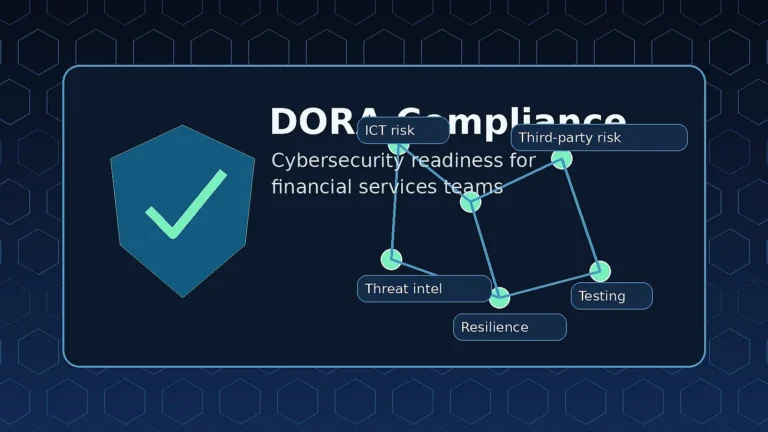
DORA is often discussed through five connected pillars. Each pillar has compliance implications, but each also maps to concrete security operating practices.
DORA requires financial entities to maintain an ICT risk management framework that covers identification, protection, prevention, detection, response, recovery, and communication. Cybersecurity teams need an accurate view of the environment before they can manage risk. That includes endpoints, servers, cloud assets, containers, applications, identities, external attack surface, network infrastructure, code repositories, and the findings generated by existing scanners.
Many financial services organizations already own several scanners and security tools. The problem is fragmentation. Vulnerabilities sit in one platform, cloud misconfigurations in another, external exposures in another, and business context in spreadsheets or CMDB records. A DORA-ready program needs to unify this evidence so teams can prioritize what matters to critical functions.
Cyber asset attack surface visibility is a practical starting point because it connects assets, vulnerabilities, exposures, and business context in one operating view.
DORA expects financial entities to manage, classify, and report major ICT-related incidents. That requires more than an incident response plan stored in a shared drive. Teams need data that helps them classify severity, understand affected assets, identify exploitability, trace root causes, and determine whether critical functions are impacted.
Incident readiness improves when exposure data is already normalized and enriched before an event. If the security team can quickly see affected assets, active exploitation signals, known attack paths, compensating controls, and remediation ownership, incident classification becomes faster and more accurate.
DORA requires regular testing of ICT systems and, for certain entities, more advanced testing such as threat-led penetration testing. The goal is to prove that controls and recovery capabilities work under realistic conditions.
Cybersecurity teams should treat testing as a continuous feedback loop instead of a once-a-year exercise. Vulnerability scans identify potential weaknesses. Breach and attack simulation and attack path analysis show whether those weaknesses can be exploited in a realistic sequence. Control validation confirms whether prevention and detection layers perform as expected.
Hive Pro supports this approach through security control validation, helping teams move from assumed protection to validated resilience.
DORA places strong emphasis on managing ICT third-party risk across the full lifecycle. Financial entities must understand which providers support critical or important functions, assess risks before contracts are signed, maintain information registers, monitor ongoing risk, and plan exit strategies where needed.
Third-party cybersecurity cannot be limited to questionnaires. Financial entities also need technical evidence of exposures connected to vendors, SaaS platforms, outsourced services, cloud providers, and externally facing systems. Supplier concentration risk becomes more meaningful when it is connected to asset criticality, known vulnerabilities, attack surface exposure, and operational impact.
DORA supports the sharing of cyber threat information and intelligence among financial entities. For cybersecurity leaders, this reinforces the need to operationalize threat intelligence, not just collect feeds.
Threat intelligence is useful when it helps teams focus. Which CVEs are being exploited? Which threat actors are targeting the financial sector? Which attack techniques are relevant to the organization’s current exposure? Which assets are connected to critical business functions? These questions help teams make better remediation and control decisions.
Hive Pro’s vulnerability and threat prioritization capabilities align with this need by combining exposure data with real-world threat context.
Most financial institutions do not fail because they lack security tools. They struggle because evidence is scattered, priorities are unclear, and remediation is slow. DORA increases pressure on the areas where security operations and compliance operations often disconnect.
Financial services environments are hybrid, distributed, and constantly changing. Legacy systems, cloud workloads, internet-facing applications, APIs, containers, and third-party services all create exposure. If asset data and findings remain scattered across scanners, teams cannot confidently explain which risks affect critical or important functions.
CVSS scores are useful, but they do not tell the full operational risk story. A high-scoring vulnerability on an isolated asset may matter less than a lower-scoring exposure on a critical payment system with active exploitation in the wild. DORA pushes teams to evaluate risk in context, especially when resilience and continuity are at stake.
Compliance deadlines and incident reporting windows make manual workflows painful. When analysts spend hours deduplicating findings, assigning tickets, validating fixes, and preparing reports, remediation slows down. DORA-ready cybersecurity programs need automation that connects risk decisions to remediation ownership.
Security teams often assume controls work because they are deployed. DORA’s resilience focus demands stronger proof. Can the organization demonstrate that controls detect relevant techniques? Can teams validate that critical attack paths are blocked? Can leaders see whether exposure is decreasing over time?
Continuous Threat Exposure Management, or CTEM, gives financial services teams a practical operating model for DORA. Instead of managing vulnerability lists in isolation, CTEM continuously scopes, discovers, prioritizes, validates, and mobilizes remediation against the exposures that matter most.
Continuous Threat Exposure Management is especially relevant to DORA because it connects regulatory outcomes to day-to-day cyber risk reduction. The regulation asks organizations to understand ICT risk, test resilience, manage third-party exposure, and report with evidence. CTEM provides the operational loop that makes those activities continuous.
The first CTEM step is to define what matters. For DORA, this means identifying assets, systems, applications, services, and vendors that support critical or important business functions. Scoping helps teams avoid generic risk management and focus on the systems that could affect operational continuity, transaction integrity, customer trust, or regulatory obligations.
Discovery means continuously identifying assets, vulnerabilities, misconfigurations, identity risks, cloud exposures, web application weaknesses, code risks, and external attack surface issues. This supports the ICT risk management foundation required by DORA.
Hive Pro’s Uni5 Xposure platform is built to unify findings from existing tools while also supporting native scanning across code, container, cloud, web, network, mobile, and external attack surface environments.
DORA does not ask teams to patch every issue at the same speed. It expects proportionate, risk-based management. Prioritization should account for exploitability, threat actor activity, asset criticality, compensating controls, exposure paths, and business impact. This helps financial services teams focus scarce remediation capacity on the risks most likely to affect resilience.
Validation is where CTEM becomes especially valuable for DORA. Vulnerability data tells teams what might be wrong. Validation shows what can be exploited, which attack paths matter, and whether controls are performing. This supports resilience testing, control assurance, and executive reporting.
Mobilization connects findings to action. Teams need workflows that assign owners, track remediation, validate closure, and produce reporting for security and compliance stakeholders. Without mobilization, DORA evidence becomes a reporting exercise instead of a resilience improvement program.
Want to see how CTEM can support DORA readiness across discovery, prioritization, validation, and remediation? Learn more about Uni5 Xposure.
Hive Pro helps financial services cybersecurity teams connect DORA requirements to operational evidence. The value is not only in finding more issues. The value is in helping teams identify the exposures that matter, validate them, and remediate faster.
| DORA Focus Area | Cybersecurity Need | How Hive Pro Helps |
|---|---|---|
| ICT risk management | Continuous visibility across assets, vulnerabilities, and exposures | Unified exposure management across existing scanners, native scans, cloud, code, web, network, mobile, and external attack surface |
| Incident readiness | Faster classification and impact analysis | Threat-enriched exposure context, asset criticality, attack path insight, and remediation status |
| Resilience testing | Evidence that controls and defenses work | Breach and attack simulation, attack path analysis, and security control validation |
| Third-party risk | Visibility into vendor-connected exposure and external attack surface | External attack surface management and context-driven prioritization of supplier-related exposures |
| Information sharing | Actionable threat intelligence | HiveForce Labs intelligence and threat-informed prioritization tied to real-world exploitation |
This mapping is useful for CISOs because it turns DORA into an operating model. Compliance leaders get evidence. Security operations teams get focus. Executives get clearer reporting on risk reduction and resilience.
Financial services teams can use the following checklist to evaluate whether their cybersecurity program is ready to support DORA obligations.
Teams that treat this checklist as a continuous loop will be better prepared than teams that only prepare evidence before an audit.
No. DORA is a regulatory requirement, but its cybersecurity impact is operational. It requires financial entities to manage ICT risk, test resilience, oversee third parties, report incidents, and use threat information in a more coordinated way. The goal is stronger operational resilience, not paperwork alone.
DORA increases the need for risk-based vulnerability management. Financial services teams must understand which vulnerabilities affect critical ICT assets, which are exploitable, which are tied to active threats, and which could disrupt important business functions. This makes CTEM and threat-informed prioritization highly relevant.
DORA includes digital operational resilience testing obligations, and certain financial entities are subject to advanced testing requirements such as threat-led penetration testing. Even when advanced testing is not required for every entity, continuous validation, attack path analysis, and control testing help demonstrate resilience.
Financial entities should maintain a clear inventory of ICT third-party providers, classify which providers support critical or important functions, assess risk before and during relationships, monitor concentration risk, and prepare exit strategies. Cybersecurity teams should support this with technical exposure data and external attack surface visibility.
Start by connecting critical business functions to ICT assets, vulnerabilities, third parties, and existing controls. This creates the foundation for risk prioritization, incident readiness, resilience testing, and executive reporting.
DORA compliance cybersecurity is not a one-time project. It is a continuous operating discipline. Financial services organizations need to know what they own, which exposures matter, whether defenses work, how third parties affect resilience, and how quickly teams can reduce risk.
That is why DORA aligns so closely with Continuous Threat Exposure Management. CTEM turns risk management into a repeatable loop: scope the environment, discover exposure, prioritize with threat and business context, validate what can be exploited, and mobilize remediation. For financial services teams under regulatory pressure, that loop creates a stronger path from compliance evidence to measurable resilience.
Ready to strengthen DORA readiness with continuous exposure management? See how Hive Pro helps financial services teams reduce exposure and protect critical operations.
For the official legal text, financial services teams can review Regulation (EU) 2022/2554 on EUR-Lex.