 Critical Threat Research : The Iranian Cyber War Intensifies!


Comprehensive Threat Exposure Management Platform
Your organization collects vulnerability data from dozens of tools, yet your team still struggles to answer one critical question: which threats actually matter right now? The gap between raw security data and actionable insight is where most organizations lose the battle against attackers. Cyber threat intelligence (CTI) bridges that gap by transforming raw data into context-rich, prioritized intelligence that drives faster, smarter decisions.
See how Hive Pro’s threat intelligence capabilities power smarter vulnerability prioritization.
This guide breaks down what cyber threat intelligence is, the four types security teams rely on, the six-phase lifecycle that turns raw data into action, and how to operationalize CTI within your existing security program.
Cyber threat intelligence is the process of collecting, processing, and analyzing data about current and emerging cyber threats to produce actionable insights that inform security decisions. Unlike raw threat data, which might include millions of indicators of compromise (IoCs), CTI adds context: who is attacking, why, how, and what assets are at risk.
The distinction matters. A threat feed showing a malicious IP address is data. Knowing that IP belongs to a ransomware group actively targeting healthcare organizations using a specific vulnerability in your environment, and that your current controls do not block their preferred attack path, is intelligence.
CTI enables security teams to move from reactive firefighting to proactive defense. Instead of treating every vulnerability as equally urgent, threat intelligence helps you focus resources on the threats most likely to impact your organization.
The sheer volume of vulnerabilities disclosed each year makes prioritization essential. In 2025, over 30,000 CVEs were published, yet only a fraction were actively exploited in the wild. Without threat intelligence, security teams default to CVSS scores alone, which do not account for real-world exploitability, attacker interest, or your specific environment.
CTI addresses this by answering three questions traditional vulnerability management cannot:
Organizations that integrate threat intelligence into their security operations report faster mean time to respond (MTTR), reduced alert fatigue, and more efficient allocation of remediation resources.
Not all threat intelligence serves the same purpose. Understanding the four types helps security leaders match intelligence to the right audience and use case within their organization.
Strategic intelligence provides a high-level view of the threat landscape designed for executives and board members. It focuses on trends, geopolitical risks, and long-term threat patterns rather than technical details.
Audience: CISOs, board members, risk committees
Format: Reports, briefings, trend analyses
Example: A quarterly report showing that ransomware attacks on the financial sector increased 40% year-over-year, with state-sponsored groups shifting tactics toward supply chain compromise.
Strategic intelligence informs budget decisions, risk appetite discussions, and security program direction. It answers the question: what should we be worried about over the next 6 to 12 months?
Tactical intelligence focuses on the tactics, techniques, and procedures (TTPs) that threat actors use. Mapped to frameworks like MITRE ATT&CK, tactical intelligence helps security teams understand how attacks unfold step by step.
Audience: Security architects, detection engineers, SOC analysts
Format: TTP reports, MITRE ATT&CK mappings, playbooks
Example: Analysis showing that a threat group uses spear-phishing with macro-enabled documents for initial access, followed by PowerShell-based lateral movement and Cobalt Strike for command and control.
Tactical intelligence drives detection rule creation, security architecture decisions, and incident response playbooks. It helps teams prepare for the specific methods attackers use, not just the vulnerabilities they exploit.
Operational intelligence provides details about specific, ongoing attack campaigns. It typically includes information about the threat actor, their targets, timing, and objectives.
Audience: SOC teams, incident responders, threat hunters
Format: Campaign reports, threat actor profiles, attack timelines
Example: Intelligence indicating that APT29 is conducting a phishing campaign targeting government contractors using a newly disclosed zero-day in a widely deployed VPN appliance, with attacks expected to escalate over the next two weeks.
This type of intelligence has a shorter shelf life but higher immediate value. It drives urgent actions like emergency patching, targeted threat hunting, and enhanced monitoring of specific attack vectors.
Technical intelligence consists of specific, machine-readable indicators of compromise: IP addresses, domain names, file hashes, malware signatures, and URLs associated with malicious activity.
Audience: Security tools (SIEM, firewall, EDR), SOC analysts
Format: IoC feeds, STIX/TAXII data, YARA rules
Example: A feed containing the SHA-256 hashes of malware samples used in an active campaign, along with the command-and-control domains they communicate with.
Technical intelligence has the shortest lifespan, as attackers frequently rotate infrastructure. However, it provides the most direct, automated defensive value when integrated into security tools for real-time blocking and detection.
Effective CTI programs follow a structured six-phase lifecycle that transforms raw data into actionable intelligence. Each phase builds on the previous one, creating a continuous loop of improvement.
The lifecycle begins with defining intelligence requirements. Security leaders work with stakeholders across the organization to identify the questions CTI needs to answer.
Key activities include:
Without clear direction, CTI programs produce intelligence that nobody uses. This phase ensures every collection effort ties back to a business need.
Collection involves gathering raw data from multiple sources. The breadth and quality of sources directly impacts the value of the final intelligence product.
Common collection sources include:
The challenge is not a lack of data but too much of it. Effective collection focuses on sources aligned with the PIRs defined in Phase 1.
Raw data must be normalized, deduplicated, enriched, and structured before analysis can begin. Processing transforms disparate data formats into a consistent, usable format.
This phase involves:
Automation plays a critical role here. Manual processing cannot keep pace with the volume of data modern security environments generate. Platforms that automate ingestion, normalization, and enrichment, like Hive Pro’s Uni5 Xposure, dramatically reduce the time from raw data to usable intelligence.
Analysis is where data becomes intelligence. Analysts interpret processed data to produce findings, assessments, and recommendations tailored to specific audiences.
Key analytical activities include:
Analysis requires both technical skill and contextual understanding of the organization’s environment, industry, and risk tolerance. The output should directly inform decision-making, not just describe what happened.
Intelligence is only valuable if it reaches the right people in the right format at the right time. Dissemination matches intelligence products to their intended consumers.
| Audience | Intelligence Type | Delivery Format |
|---|---|---|
| Board / C-Suite | Strategic | Executive briefings, quarterly reports |
| Security architects | Tactical | TTP analyses, MITRE mappings |
| SOC / IR teams | Operational | Campaign alerts, threat actor updates |
| Security tools | Technical | Automated IoC feeds, STIX/TAXII |
| Vulnerability management | All types | Prioritized remediation lists |
Effective dissemination also means adjusting the level of detail and technical depth based on the audience. A board briefing requires different framing than an analyst’s threat hunt hypothesis.
The final phase closes the loop by evaluating how effectively the intelligence met stakeholder needs. Feedback drives continuous improvement of the entire lifecycle.
Questions to assess effectiveness:
Organizations that skip this phase risk producing intelligence that becomes increasingly disconnected from actual security needs.
Standing up a CTI program does not require a massive budget or a dedicated team of analysts from day one. Start with these foundational steps:
Work backward from business risk. Identify your crown jewel assets, the threat actors most likely to target your industry, and the attack techniques that keep your CISO up at night. These become your priority intelligence requirements.
Most organizations already have substantial intelligence sources they underutilize: SIEM logs, EDR data, vulnerability scan results, and email gateway alerts. Correlating these internal sources with external threat feeds creates immediate value without additional investment.
Threat intelligence should not sit in a silo. Embed it into vulnerability management for prioritization, into SOC operations for detection and triage, and into incident response for faster containment.
For vulnerability management specifically, integrating threat intelligence transforms how teams prioritize remediation. Instead of chasing thousands of vulnerabilities ranked by CVSS alone, teams focus on the handful being actively exploited by threat actors targeting their industry.
Manual intelligence processing does not scale. Invest in platforms that automate collection, normalization, enrichment, and dissemination. This frees analysts to focus on the high-value analytical work that machines cannot replicate.
Track metrics that demonstrate CTI program value: reduction in mean time to detect (MTTD), faster patching of actively exploited vulnerabilities, fewer false positives in alerting, and improved board-level threat awareness.
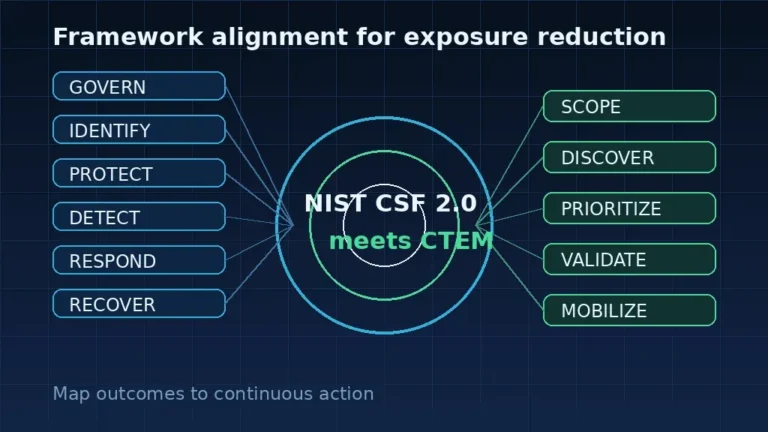
Cyber threat intelligence reaches its full potential when embedded within a Continuous Threat Exposure Management (CTEM) framework. CTEM, introduced by Gartner, provides a structured five-stage process for continuously managing threat exposure: scoping, discovery, prioritization, validation, and mobilization.
CTI powers the prioritization and validation stages of CTEM. Without threat intelligence, prioritization defaults to static vulnerability scores. With it, organizations prioritize based on which vulnerabilities are being actively exploited, which threat actors target their industry, and which attack paths lead to their most critical assets.
Validation, through breach and attack simulation, tests whether existing security controls actually stop the threats that intelligence has identified. This closes the loop between knowing about a threat and confirming your defenses work against it.
Hive Pro’s Uni5 Xposure platform implements this approach end to end. HiveForce Labs, Hive Pro’s in-house threat research team, provides the intelligence that feeds the platform’s Unictor engine. Unictor enriches vulnerability data with real-time threat context, maps it against your asset inventory and business criticality, and surfaces the top 3% of risks that require immediate action.
Explore how Hive Pro operationalizes threat intelligence within a full CTEM framework.
Cyber threat intelligence is the process of collecting, analyzing, and contextualizing data about cyber threats to produce actionable insights. It goes beyond raw data by adding context about who is attacking, their methods, targets, and motivations, enabling security teams to make informed, proactive decisions.
The four types are strategic (high-level trends for executives), tactical (TTPs and attack methods for security teams), operational (details about specific ongoing campaigns), and technical (machine-readable indicators like IP addresses and file hashes for automated defenses).
The threat intelligence lifecycle is a six-phase process: planning and direction, collection, processing, analysis, dissemination, and feedback. It provides a structured framework for transforming raw threat data into actionable intelligence and continuously improving the program’s effectiveness.
CTI enables organizations to prioritize vulnerabilities based on real-world exploitation data rather than static CVSS scores alone. By identifying which vulnerabilities threat actors are actively targeting, security teams can focus remediation on the threats that pose the greatest actual risk.
Threat data consists of raw, unprocessed indicators such as IP addresses, file hashes, or vulnerability disclosures. Threat intelligence adds context, analysis, and relevance: it tells you not just that a threat exists but whether it is relevant to your organization, how likely it is to be exploited, and what actions to take.