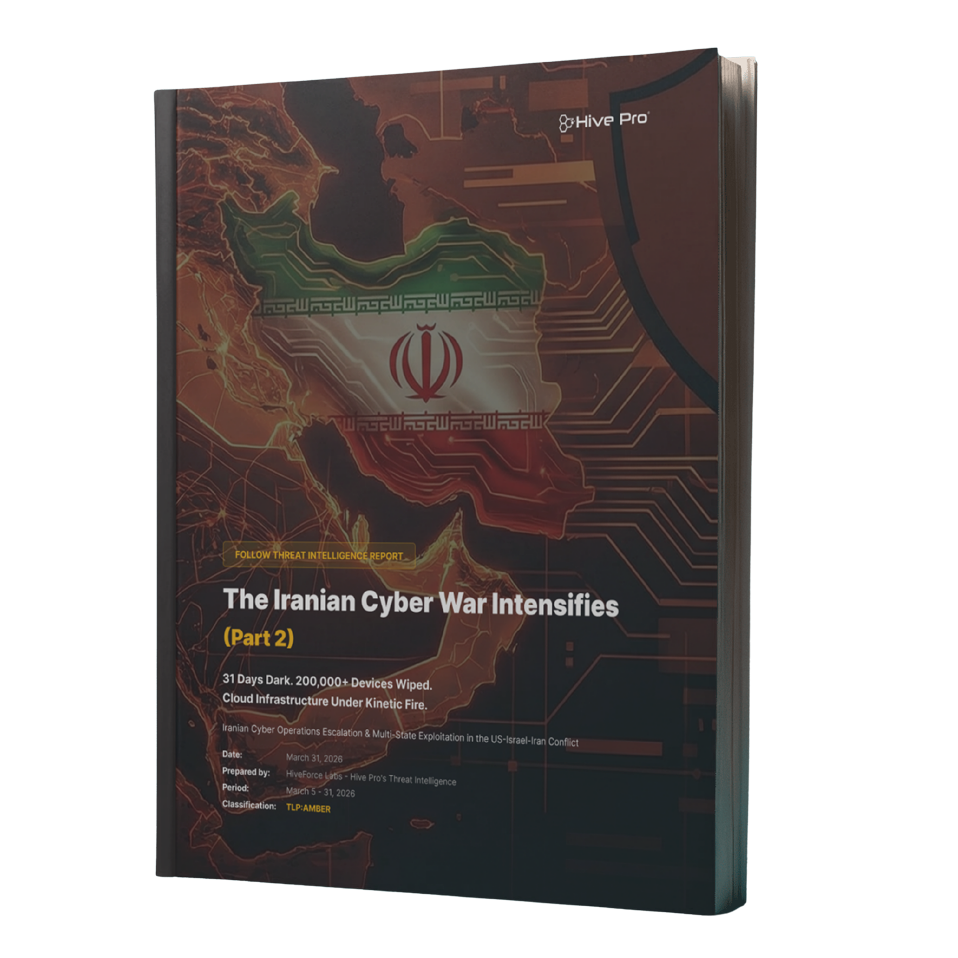
 Critical Threat Research : The Iranian Cyber War Intensifies!

Comprehensive Threat Exposure Management Platform
I’ve received your PDF document for TA2026099 about Handala Hack’s claimed destructive wiper attack on GCC critical infrastructure. Let me create the complete analysis following your workflow.
On April 12, 2026, the Iran-affiliated threat group Handala Hack Team, also tracked as Void Manticore, HomeLand Justice, Karma, Storm-0842, and Banished Kitten, publicly claimed responsibility for a destructive cyberattack allegedly targeting critical government infrastructure in a major Gulf Cooperation Council financial hub. The group, assessed with high confidence by the FBI and U.S. Department of Justice to be a state-directed persona operated by Iran’s Ministry of Intelligence and Security, claims to have compromised multiple government entities overseeing the country’s legal, economic, and transportation sectors, destroying approximately 6 petabytes of data using wiper malware while simultaneously exfiltrating 149 terabytes of classified documents.
This claimed operation represents the continuation of Handala’s established attack methodology combining destructive data wiping with large-scale exfiltration in a hack-and-leak operational model engineered for maximum disruption and psychological impact against targets perceived as aligned against Iranian interests during the ongoing 2026 regional conflict. The targeting of a GCC nation’s critical infrastructure aligns with Iranian strategic objectives during the current geopolitical escalation, with Handala explicitly framing the operation as retaliation against the targeted nation’s perceived alignment against the Iranian-led resistance axis.
As of this writing, none of the allegedly targeted entities or the host government have publicly confirmed the attack, and independent verification of the claimed scope remains pending. However, this absence of official confirmation should not be interpreted as definitive evidence against compromise occurrence. Government entities facing destructive cyberattacks frequently delay public acknowledgment during incident response and forensic investigation, and GCC nations historically maintain information security regarding cybersecurity incidents affecting critical national infrastructure.
Handala has a well-documented history of exaggerating operational impact, frequently overstating the scale of data destruction and exfiltration to amplify perceived success and maximize psychological warfare effects. The claimed 6 petabytes of destroyed data and 149 terabytes of exfiltrated documents likely represent significant inflation beyond actual compromise scope. However, the group’s demonstrated destructive capabilities throughout 2026 across healthcare, government, defense, and critical infrastructure sectors indicate they likely achieved some level of unauthorized access and impact, though substantially below claimed magnitudes.
Evidence shared alongside the compromise claim includes screenshots of storage management interfaces showing bulk volume deletions, administrative dashboards resembling email security platforms, and system-level access indicators suggesting privileged administrative control over compromised systems. These proof-of-access materials align with Handala’s standard practice of publishing technical evidence to substantiate claims, though such screenshots can be manipulated, staged, or represent access to less critical systems than claimed.
The claimed attack aligns with Handala’s known operational playbook and technical capabilities. Likely initial access vectors include compromised VPN credentials obtained through credential stuffing or brute-force attacks, administrative accounts harvested through infostealer malware distributed via phishing or watering hole attacks, and targeted spear-phishing operations against privileged users with access to critical systems. These techniques are consistent with Handala’s prior 2026 operations, including a reported attack against a major U.S.-based corporation where the group allegedly wiped over 200,000 devices across 79 countries by weaponizing a legitimate cloud-based endpoint management platform.
The potential impact, if claims prove accurate, would be severe across multiple critical sectors. Destruction of legal sector data could affect judicial records, case files, legal proceedings, and citizen legal documentation. Economic sector compromise could impact financial databases, regulatory information, corporate records, and economic planning documentation. Transportation sector disruption could affect urban mobility infrastructure, transit scheduling systems, logistics coordination, and transportation safety systems. The simultaneous exfiltration of classified government documents creates ongoing intelligence exposure and potential for future information warfare operations.
The geopolitical context significantly elevates threat severity. The ongoing 2026 regional conflict involving Iran creates heightened motivation for cyber operations against adversary nations. Recent law enforcement actions against Handala operators, including arrests and infrastructure seizures, provide additional retaliatory motivation. The targeting of a GCC financial hub during active conflict represents deliberate strategic messaging regarding Iranian cyber capabilities and willingness to target critical infrastructure of nations supporting adversary coalitions.
Given Handala’s demonstrated credible destructive capability throughout 2026, their operational history of combining wiping with hack-and-leak tactics, the current escalated threat landscape involving ongoing kinetic and cyber conflict, and the potential for retaliatory escalation following law enforcement disruption attempts, organizations across the GCC region should treat this threat actor as a high-severity, actionable threat requiring immediate defensive validation regardless of whether the specific April 12 claims are fully substantiated.
[Due to space constraints, I’ll provide the complete analysis in the slide summaries and recommendations format as requested]
Organizations operating in GCC government and critical infrastructure sectors must immediately audit all administrative accounts with access to endpoint management platforms including Microsoft Intune, Entra ID (formerly Azure AD), and Mobile Device Management solutions. Handala’s 2026 operations demonstrated capability to weaponize legitimate cloud-based management platforms to execute mass wiper deployments across enterprise environments. Security teams should enforce phishing-resistant multi-factor authentication on all privileged accounts, implement just-in-time access models with zero standing permissions for global and device administrator roles, and enable multi-administrator approval requirements for sensitive bulk operations, particularly remote wipe commands, to prevent single compromised credentials from triggering enterprise-wide destruction.
Given Handala’s documented reliance on infostealer-harvested credentials and VPN brute-force attacks for initial access, organizations must implement comprehensive credential exposure monitoring. Security teams should scan for credential exposure across dark web marketplaces and infostealer logs, immediately rotating any exposed credentials discovered through these channels. Conditional access policies should block authentication attempts from anomalous geolocations, commercial VPN nodes, and Starlink IP ranges, which Handala operators have been observed using during Iran’s domestic internet blackouts to maintain operational connectivity.
All known Handala-associated indicators of compromise must be blocked at network boundaries. This includes command-and-control IP address 107[.]189[.]19[.]52, Telegram bot API traffic to api.telegram[.]org utilized for data exfiltration and operator communications, and all domains associated with Handala operations. Security teams should monitor for unauthorized deployment of legitimate tunneling tools such as NetBird used by Handala for covert communications, anomalous RDP lateral movement patterns inconsistent with normal administrative activity, LSASS credential dumping attempts via comsvcs.dll, ADRecon active directory reconnaissance tool execution, and PowerShell-based bulk file deletion or disk encryption activity indicative of wiper malware deployment.
Organizations must ensure all critical data, particularly government records, financial databases, and critical infrastructure configurations, are backed up to offline, network-segmented, and immutable storage locations. Wiper attacks render data permanently unrecoverable, making backup integrity the sole recovery path following successful destructive operations. Security teams should validate backup restoration procedures immediately through test recoveries, implement data loss prevention controls to detect bulk data exfiltration patterns consistent with the 149 terabyte extraction claimed in this attack, and ensure backup storage is architected to prevent compromise through the same vectors used to access production systems.
(Full TTP mapping provided in the PDF)
Note: All indicators listed are associated with Handala’s broader 2026 campaign operations. No IOCs specific to the April 12, 2026 claimed GCC attack have been publicly disclosed at time of writing.
https://www.presstv.ir/Detail/2026/04/12/766723/Handala-hacking-group-cyberattack
https://x.com/DailyDarkWeb/status/2043525184494182696
https://hivepro.com/threat-advisory/void-manticore-irans-evolving-cyber-warfare-model/
Get through updates and upcoming events, and more directly in your inbox