Comprehensive Threat Exposure Management Platform
Hive Pro recognized in Gartner® Magic Quadrant™ for Exposure Assessment Platform, 2025 Watch platform in action

See how Rapid7 and Hive Pro compare in features, setup, pricing, and threat intelligence to help you choose the right threat exposure management platform.

Threat intelligence and Business context are the secret sauces that transform vulnerability management from a frantic game of whack-a-mole into a strategic, focused risk management and security practice.
Without it, you’re just staring at a massive list of vulnerabilities with little to no context to decide what to fix first. The quality of this intelligence determines whether you’re chasing low-risk issues or stopping real-world attacks before they happen. It’s the difference between knowing you have a thousand unlocked doors and knowing which three an intruder is actively trying to open.
Rapid7 and Hive Pro both are popular vulnerability and exposure management players in the markets but they aren’t the same. Let’s explore how they compare in sourcing and applying threat intelligence and business context to help you prioritize vulnerabilities that truly matter.
Choosing the right vulnerability exposure management platform is a big decision. Both Rapid7 and Hive Pro are strong contenders, but they approach the problem from different angles. Rapid7 is a well-known name in vulnerability management, focusing on comprehensive scanning and testing. Hive Pro, on the other hand, offers a next-generation, unified platform built around proactive vulnerability exposure reduction and real-world threat intelligence. Let’s break down what each platform brings to the table so you can see how they stack up.
Rapid7 has built a reputation on its ability to identify security weaknesses. Its platform, particularly InsightVM, is designed to find and assess vulnerabilities across your environment. \ This approach is rooted in traditional vulnerability management, providing teams with extensive scanning capabilities to uncover potential risks. It’s a solid tool for organizations looking for a mature solution focused on comprehensive vulnerability discovery and assessment. For teams that need deep scanning features and have the resources to manage the resulting data, Rapid7 provides a powerful foundation.
Hive Pro takes a different path by centering its platform on a continuous and unified view of your entire threat exposure. Instead of just finding vulnerabilities, Hive Pro helps you understand which ones pose an immediate threat. The platform’s main strength is its tight integration with threat intelligence from our in-house HiveForce Labs, allowing you to prioritize vulnerabilities based on real-time data. This means you can focus your team’s efforts on fixing the issues that attackers are actively exploiting right now. It’s a strategic shift from a reactive, checklist-based approach to a proactive, threat-informed defense that helps you stay ahead of emerging threats.
When it comes to managing your attack surface, the key differences are speed, context and ease. While Rapid7 provides powerful scanning, in addition to the powerful scanning capabilities Hive Pro is built for faster deployment and more comprehensive, unified asset coverage. This allows you to get a complete picture of your exposure quickly, without a lengthy setup process.
More importantly, Hive Pro goes beyond just identifying risks by providing proven security control validation. This helps you confirm that your security measures are actually working as intended against real-world threats. By focusing on threat-informed visibility and prioritization, organizations can achieve measurable success and build a more resilient security posture based on what’s happening in the wild, not just what a scan finds.
When you’re trying to get ahead of threats, a lengthy setup process is the last thing you need. The time it takes to get a new security platform running directly impacts how quickly you can reduce risk. A long implementation drains resources and leaves you waiting for insights while your attack surface remains exposed. Let’s compare how quickly you can get started with Hive Pro versus Rapid7, from initial setup to daily management.
With Hive Pro, you can go from kickoff to actively identifying vulnerabilities in about two hours. Because the platform is a cloud-native SaaS solution, there’s no complex software to install or on-premise hardware to configure. You simply connect your assets, and the system starts working. This rapid deployment means your team can achieve value almost immediately. Instead of spending weeks on implementation, you can focus on what matters: analyzing your exposure. The Hive Pro Platform is designed for speed, helping you get a clear picture of your security posture on day one, not a month from now.
In contrast, getting started with Rapid7 is a more involved process, typically taking three to four weeks. This extended timeline is often due to the need to install and configure on-premise scanners and other software components across your network. A multi-week implementation requires significant planning and ties up your team’s time, pulling them from other critical security tasks. While your team is focused on getting the tool to work, new vulnerabilities could be emerging. This delay in achieving full operational capacity means a longer wait to get the comprehensive visibility you need, extending your organization’s potential risk.
Beyond initial setup, day-to-day management complexity is a key difference. Hive Pro simplifies this with a single, unified SaaS console. From one dashboard, you can manage all your assets, whether they’re on-premise, in the cloud, or remote. This gives you a truly comprehensive view of your Total Attack Surface Management without juggling multiple systems. Rapid7, on the other hand, often requires separate systems and consoles to manage different types of assets. This siloed approach can make it difficult to get a cohesive picture of your overall risk, adds to the administrative workload, and can introduce inconsistencies in your vulnerability management program.
When you look at how each platform handles vulnerability management, the core difference comes down to philosophy: traditional scanning versus next-generation vulnerability exposure management. While both aim to find weaknesses, their vulnerability coverage, methods for assessing, prioritizing, and contextualizing those weaknesses are worlds apart.
Rapid7 Hive Pro Rapid7 has Limited CVE coverage of 180,000 as compared to Hive Pro’s comprehensive coverage of 326,000 CVEs Rapid7 only Only uses signature based vulnerability assessment,Hive Pro Uses both signature and non-signature based vulnerability detections Rapid7 prioritises CVEs based on exploit available in Metasploit, Hive Pro Prioritises CVEs based on threat activity, active exploitation and threat relevance
Rapid7’s approach is rooted in signature based detection. It uses signature based techniques to find security gaps across your network and applications. This process is designed to give you a list of all the potential issues that need attention. The platform is effective at identifying known CVEs and misconfigurations through its scanning engine. However, this method can generate a high volume of findings, leaving it up to your team to sift through the noise and figure out which vulnerabilities pose a genuine, immediate threat to your specific organization.
Hive Pro shifts the focus from simply finding vulnerabilities to eliminating vulnerability blind spots and to proactively reducing your threat exposure. Hive Pro uses both signature and non-signature based vulnerability detection methods to identify over 326K CVEs. Its strength lies in its deep integration with threat intelligence, which allows you to see which vulnerabilities are actively being exploited in the wild. Instead of just giving you a long list of potential problems, Hive Pro’s vulnerability and threat prioritization capabilities help you concentrate on the issues that matter most right now. This model helps you move from a reactive cycle of patching everything to a strategic approach where you remediate the highest-risk exposures first, saving your team valuable time and resources.
The way each platform scores risk highlights their different philosophies. Rapid7 uses a 1-1000 scale, but this score often lacks the real-world threat context needed for effective prioritization. It doesn’t account for active exploitation of vulnerabilities or the business criticality of the affected asset. In contrast, Hive Pro provides a more intuitive 1-100 risk score. This score is far more useful because it’s calculated using multiple factors, including threat intelligence, asset importance, and exploitability. This gives you a clear, actionable number that accurately reflects the true risk to your business.
Your attack surface is more than just servers and workstations. Hive Pro is designed for total attack surface management, giving you visibility across all your digital assets. This includes traditional IT infrastructure like computers and servers, as well as cloud environments, applications, source code, and even IoT devices. This comprehensive coverage ensures you don’t have blind spots where threats could be hiding. Rapid7, on the other hand, has more limited coverage. It doesn’t provide visibility into areas like your source code, which can leave critical application security gaps unaddressed in your vulnerability management program.
Finding vulnerabilities is one thing, but knowing if they actually open a door for an attacker is another game entirely. This is where Breach and Attack Simulation (BAS) comes in. Think of it as a continuous, automated exposure validation for your security controls. Instead of just relying on a vulnerability scanner’s report, BAS tools actively test your defenses by simulating the same tactics and techniques real attackers use. This proactive approach helps you answer the critical question: “Could an attacker actually get through?”
Running these simulations gives you a true-to-life picture of your security posture. You can see exactly where your defenses hold strong and where they crumble under pressure. This is a huge step up from traditional vulnerability management, which often leaves you with a long list of potential issues but little context on which ones pose an immediate threat. By safely mimicking real-world attack scenarios, you can validate that your security tools are configured correctly, your incident response plans work as expected, and your team is ready for a real event.
“BAS capabilities when tightly coupled or delivered out of the same vulnerability exposure management is more useful and easy to operationalize rather than an add-on tool.”
Rapid7 doesn’t offer Exposure Validation or Breach and Attack Simulation Capabilities on the platform. Rapid7 managed services offer red teaming services but it is very expensive and point-in time.
Hive Pro takes a more threat-informed approach to adversarial exposure validation. Instead of just running generic attack simulations, Hive Pro’s main strength is its tight integration with real-time threat intelligence from our in-house HiveForce Labs. This means the simulations you run are based on the actual threats and attack campaigns happening in the wild right now.
This capability allows you to test your defenses against the specific tactics being used by active threat actors targeting your industry. You’re not just checking for a hypothetical breach; you’re validating your controls against relevant, timely, and probable attack paths. This intelligence-driven method helps you focus your resources on shoring up the defenses that are most likely to be tested by a real adversary.
Integrating BAS into your vulnerability management program shifts your entire strategy from reactive to proactive. For years, security teams have been stuck in a cycle of scanning, finding thousands of vulnerabilities, and then struggling to figure out which ones to fix first. BAS cuts through that noise by providing crucial context. It helps you understand the real-world effectiveness of your existing security measures.
By simulating attacks, you can see which vulnerabilities are actually exploitable in your specific environment. This helps you prioritize remediation efforts based on tangible risk, not just a CVSS score. It’s the difference between having a long to-do list and having a clear, actionable plan focused on the weaknesses that matter most to your organization’s security.
The threat landscape changes by the minute, which is why the testing model you choose is so important. Periodic testing, like an annual penetration test, provides a valuable snapshot in time, but that picture can become outdated almost immediately. A new vulnerability or attack technique can emerge the next day, leaving you with a false sense of security.
Continuous testing, on the other hand, allows for the ongoing validation of your security controls. This model ensures you can quickly identify and adapt to new threats as they appear. By constantly testing your defenses against the latest attack simulations, you close the gaps that periodic testing inevitably leaves open. This aligns with a modern Continuous Threat Exposure Management (CTEM) approach, ensuring your security posture remains robust day in and day out.
Threat intelligence is the secret sauce that transforms vulnerability management from a frantic game of whack-a-mole into a strategic, focused security practice. Without it, you’re just staring at a massive list of vulnerabilities, with little context to decide what to fix first. The quality and application of threat intelligence can make or break your program, determining whether you’re chasing down low-risk issues or stopping real-world attacks before they happen. It’s the difference between knowing you have a thousand unlocked doors and knowing which three an intruder is actively trying to open.
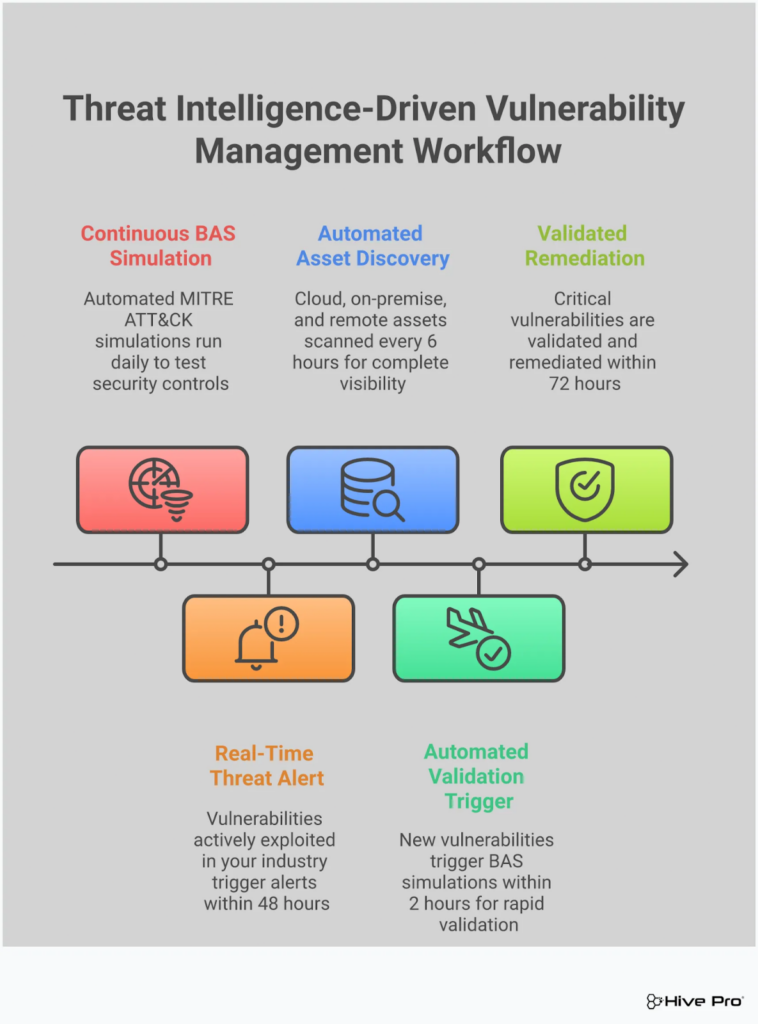
Both Rapid7 and Hive Pro use threat intelligence, but their approaches to sourcing and integrating it are fundamentally different. Rapid7’s method is built on metasploit to check whether an exploit is available or not . Hive Pro, on the other hand, centers its entire platform around real-time, human-validated threat intelligence from its in-house research team. This distinction directly impacts how you prioritize threats and manage your overall exposure. Understanding this difference is key to choosing the platform that best aligns with your goal of building a proactive, threat-informed security posture.
Rapid7’s approach to threat intelligence is limited to just metasploit and its open-source projects.
Hive Pro’s main strength is its deep integration with proprietary, real-time threat intelligence. This intelligence comes directly from HiveForce Labs, our in-house team of security researchers who continuously analyze the global threat landscape. They track active exploits, monitor threat actor campaigns, and dissect malware to understand which vulnerabilities are being targeted right now.
This isn’t just a data feed; it’s curated, human-validated intelligence that powers the entire platform. As one analysis notes, “Hive Pro’s main strength is its tight integration with threat intelligence, allowing you to prioritize vulnerabilities based on real-time data about threats.” This means your prioritization isn’t based on theoretical risk but on the actual, immediate danger posed by active threats in the wild.
The ultimate goal of threat intelligence is to help you focus your efforts where they matter most. With thousands of new vulnerabilities disclosed every year, you can’t possibly fix everything. Hive Pro is designed to cut through that noise. The platform “provides threat-informed visibility and prioritization to help organizations focus their exposure management efforts effectively.”
This means that instead of just getting a CVSS score, you see which vulnerabilities are part of an active attack campaign, which have readily available exploit kits, and which are being used by specific ransomware groups. This context allows you to direct your limited time and resources to the handful of vulnerabilities that pose a clear and present danger to your organization, moving you from a reactive to a proactive security model.
Generic risk scores can be misleading. A vulnerability with a “critical” CVSS score might be difficult to exploit and not actively targeted, while a “high” rated one could be part of a widespread ransomware campaign. This is where real-world context becomes critical. Hive Pro allows you to “prioritize vulnerabilities based on real-time data, ensuring that the most critical threats are addressed first.”
This real-time data includes threat actor associations, malware dependencies, and exploitability information from HiveForce Labs. By enriching vulnerability data with this context, Hive Pro’s risk score reflects the true, immediate risk to your business. You can confidently tell your team—and your leadership—that you are fixing the most dangerous issues first because your decisions are backed by current, actionable intelligence.
When you’re dealing with thousands of potential threats, the last thing you need is a platform that complicates your workflow. A tool should feel like an extension of your team, not another puzzle to solve. Usability isn’t just about a clean interface; it’s about how quickly your team can get meaningful results, understand the data, and take action. A platform that’s intuitive and centralizes information saves time and reduces the chance of human error, making your entire security posture stronger. Let’s look at how Hive Pro and Rapid7 stack up when it comes to day-to-day use.
One of the biggest differences you’ll notice is how you view and manage your assets. Hive Pro provides a unified platform that brings everything into a single SaaS console. Whether your assets are on-premises, in the cloud, or used by remote employees, you can see and manage them from one central hub. This approach eliminates the need to switch between different systems, which simplifies operations and closes visibility gaps. In contrast, Rapid7’s architecture often requires separate consoles to manage different parts of your environment. Juggling multiple consoles can create data silos and add unnecessary complexity for your team. A single, unified view not only streamlines management but also ensures you have a consistent and complete picture of your attack surface at all times.
A dashboard is only useful if it tells you what you actually need to know. Hive Pro focuses on providing a clear, actionable risk score on a simple 1-100 scale. This score isn’t just based on a generic CVSS rating; it’s a much richer calculation. The platform evaluates multiple factors, including the severity of a vulnerability, its age, real-world attack data from our intelligence teams, the importance of the asset, and the actual feasibility of an attack. This multi-factor approach to vulnerability and threat prioritization helps you cut through the noise and focus your resources on the threats that pose a genuine risk to your organization.
Getting a new platform up and running can be a major project, but it doesn’t have to be. The time it takes to get value from your investment is a critical factor. Hive Pro is designed for rapid deployment and can be live in as little as two hours. This means your team can start identifying and addressing exposures almost immediately, without a lengthy implementation process. Rapid7, on the other hand, typically requires a much longer setup, with an implementation timeline of three to four weeks. For teams that need to move quickly, this delay can be a significant drawback. A more user-friendly interface and a shorter learning curve mean your team spends less time in training and more time actively reducing your organization’s threat exposure.
When you’re comparing security platforms, the sticker price is only one part of the equation. The real financial impact comes from the total cost of ownership (TCO), which includes everything from initial setup and hardware to the daily operational lift required from your team. The pricing model itself can make a huge difference. A per-device fee might seem straightforward, but it can quickly become unpredictable as your organization grows. Let’s break down how Rapid7 and Hive Pro approach pricing so you can see what each platform will truly cost your organization.
Beyond the license fee, many vulnerability management solutions come with hidden costs, especially if they require on-premise hardware or extensive manual effort. These expenses include servers, maintenance contracts, and the personnel needed to manage the system. With a streamlined, cloud-native platform, you can sidestep many of these extra expenses. For example, switching to Hive Pro can save you money on hardware, daily operations, and even the software itself. By eliminating the need for dedicated hardware and automating many of the manual tasks that bog down security teams, a unified platform reduces the day-to-day operational burden and delivers a lower total cost of ownership.
Features and specs are important, but the real test of a platform is what actual security professionals think after using it day in and day out. When you look at user reviews and ratings, a clear picture emerges of each platform’s strengths and where they fall short. It’s not just about the numbers; it’s about the experience behind them, from initial setup to getting help when you need it most. Let’s see what your peers are saying about Hive Pro and Rapid7.
When a platform earns a 4.9 out of 5 rating on [Gartner Peer Insights] (https://www.gartner.com/reviews/vendor/hive-pro), it’s worth paying attention. Users consistently praise Hive Pro for its effectiveness and overall satisfaction, with 94% of them recommending it. One of the most significant factors behind this high rating is its incredibly fast time to value. Teams report that Hive Pro can be “Live in 2 hours,” a stark contrast to the 3-4 weeks often required for a Rapid7 implementation. This rapid deployment capability means your team can start identifying and reducing exposure almost immediately, without getting bogged down in a lengthy setup process.
Rapid7 holds a respectable but lower 4.3 out of 5-star rating based on hundreds of user reviews. While this shows a solid user base, it also indicates that there’s room for improvement, especially when compared to other players in the space. A 4.3 rating isn’t bad, but for teams looking for a top-tier solution, it signals that you might encounter some of the frustrations that other users have already flagged.
When you’re dealing with critical security issues, responsive and knowledgeable support is non-negotiable. This is an area where user feedback shows a clear divide. While competitors often receive praise for their excellent support teams, some customers report switching from Rapid7 specifically due to dissatisfaction with its service. When your team is under pressure to remediate a critical vulnerability, waiting on a support ticket can introduce unnecessary risk. High-quality support is a crucial part of the overall platform experience, and it’s a factor where user satisfaction appears to waver for Rapid7.
Choosing a platform isn’t just about features; it’s about finding the right fit for your team’s workflow, goals, and overall security philosophy. Both Rapid7 and Hive Pro bring distinct advantages to the table. Let’s break down where each one shines so you can see which aligns best with your organization’s needs.
Rapid7 is a well-established name in cybersecurity, and its biggest strength lies in the convergence of its solutions. If your team is already using other Rapid7 products, the Insight Platform can provide a unified view of your security posture. It’s a solid choice for organizations looking for a comprehensive, all-in-one suite from a single vendor for traditional vulnerability management. However, Rapid7 will not be able the vehicle to upgrade your vulnerability management program to the next level to Vulnerability Exposure Management.
Hive Pro’s advantage is its proactive, threat-informed approach to exposure management. Its core strength is the tight integration with threat intelligence from HiveForce Labs, which allows you to prioritize vulnerabilities based on real-time data about threats being actively exploited in the wild. This means your team stops chasing every single vulnerability and starts focusing on the ones that pose an immediate risk. Hive Pro also excels at comprehensive coverage, checking all your digital assets for issues—from servers and cloud systems to applications and IoT devices. This makes it a versatile choice for modern organizations with diverse and expanding attack surfaces.
Rapid7 is a scalable platform. However it requires constant hardware upgradation.
Hive Pro, on the other hand, is designed for efficient scaling. As a SaaS platform, it eliminates the need for on-premise hardware, making deployment faster and less complex. Its threat-informed prioritization is key to its scalability; by focusing your team on the most critical threats, it prevents the alert fatigue that can cripple security operations as an organization grows. Real-world cybersecurity case studies show how enterprises use Hive Pro to achieve measurable success, from gaining clear visibility to validating security controls.
Selecting a vulnerability management platform isn’t just about comparing feature lists; it’s about finding a solution that fits how your team actually works. The right platform should reduce friction, not add to it. Your team’s size, the complexity of your environment, and how quickly you need to act all play a huge role in this decision.
A major difference you’ll notice right away is the time to value. Hive Pro is designed for a faster setup, getting most organizations operational in about two hours with its straightforward cloud-based system. In contrast, Rapid7’s implementation is a more involved process, typically taking three to four weeks of software installation and configuration. If you’re facing immediate threats, that time difference is critical.
Beyond the initial setup, think about the daily management experience. Hive Pro simplifies oversight with a single SaaS console, allowing your team to manage every device—whether it’s on-prem, in the cloud, or remote—from one place. This unified view is a stark contrast to managing separate systems for different device types, which can complicate workflows and stretch your team’s resources thin.
Ultimately, your platform should give you a clear and complete picture of your risk. Hive Pro provides comprehensive checks across your entire digital footprint, including computers, cloud systems, applications, and IoT devices. It then applies a more intuitive risk score on a 1-100 scale, factoring in real-world threat intelligence to show you what truly needs your attention. While Rapid7 uses a 1-1000 scale, it can be less reflective of the actual risk landscape, especially when its coverage has limitations in areas like code assessment. The choice comes down to what your team needs: a fast, unified platform that provides a clear line of sight to your most critical risks, or a more traditional tool that may require more time and effort to manage.
The main difference comes down to context. Rapid7 is great at scanning and finding a wide range of potential weaknesses, but it often leaves your team to figure out which ones pose a real, immediate threat. Hive Pro takes a different approach by integrating real-time threat intelligence from our in-house research team. This means you see which vulnerabilities are actively being used in attacks right now, allowing you to prioritize based on actual danger, not just a generic severity score.
This is a huge differentiator. Because Hive Pro is a cloud-native SaaS platform, you can be up and running in about two hours. There’s no hardware to install or complex software to configure. In contrast, setting up Rapid7 is a more involved process that typically takes three to four weeks, as it often requires installing on-premise scanners and other components. If you need to see results and reduce risk quickly, that time difference is significant.
Think of a vulnerability scan as identifying an unlocked door in your house. A BAS tool, on the other hand, actually tries to open that door and walk inside. It safely simulates the techniques real attackers use to test if your security controls—like your alarm system or locks—are actually working as expected. This gives you proof of whether a vulnerability is truly exploitable in your environment, helping you focus on fixing the weaknesses that present a tangible risk.
Managing a diverse environment is much simpler with a unified view. Hive Pro provides a single SaaS console where you can see and manage all your assets, no matter where they are. This eliminates the need to jump between different systems to get a complete picture of your attack surface. Rapid7’s architecture can sometimes require separate systems for different asset types, which can create data silos and make it harder to get a cohesive view of your overall risk.
The pricing models are fundamentally different and can have a big impact on your budget. Rapid7 typically charges per device, which means your costs can grow unpredictably as your company adds more assets. Hive Pro uses a more predictable SaaS subscription model. More importantly, you should consider the total cost. With an on-premise-heavy solution, you often have hidden costs for hardware, maintenance, and the staff time needed to manage it all. A cloud-native platform like Hive Pro eliminates those extra expenses.