The Difference Between Vulnerability and Exposure Explained

Security teams scan for vulnerabilities every week. They patch, they prioritize, they report. Yet breaches keep happening, and the root cause is rarely an exotic zero-day. More often, it is a forgotten cloud instance, a misconfigured firewall rule, or a service account with default credentials sitting on the public internet. The weakness existed. But the real problem was that an attacker could reach it.
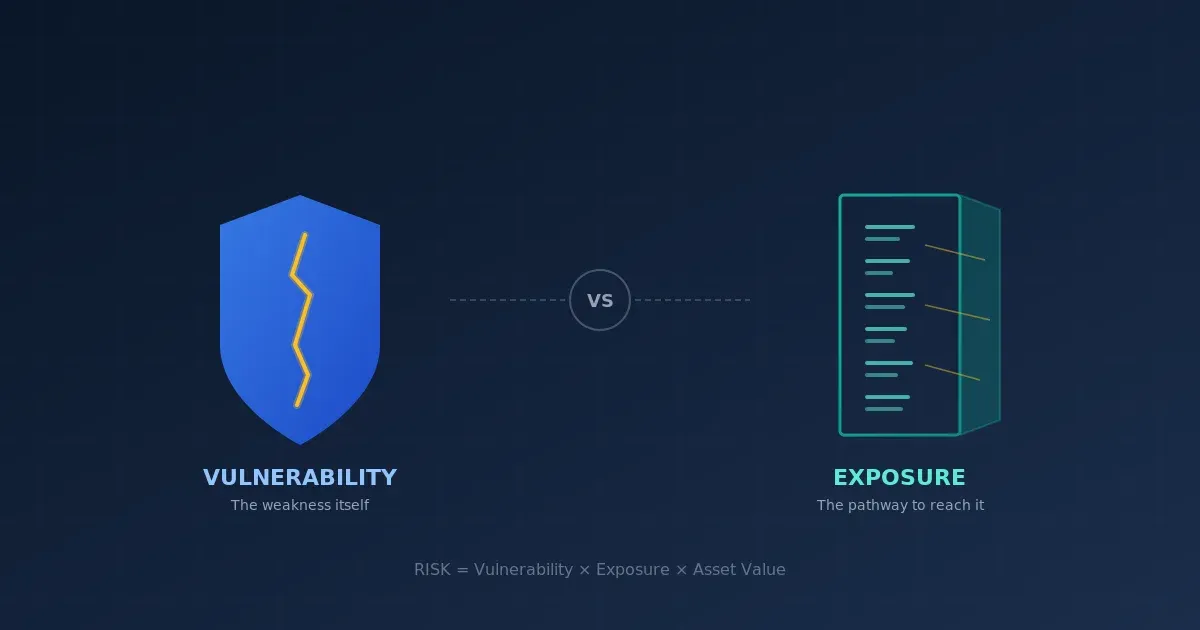
This is the core of the difference between vulnerability and exposure. A vulnerability is the flaw. An exposure is the condition that puts that flaw within an attacker's reach. Conflating the two leads to misprioritized patching, wasted remediation cycles, and a false sense of security. Getting the distinction right changes how you allocate resources, how you measure risk, and how you communicate with leadership about what actually needs fixing.
What Is a Vulnerability?
A vulnerability is a weakness in a system, application, configuration, or process that could be exploited to cause harm. It is the flaw itself, independent of whether anyone can currently reach it or whether any threat actor is actively targeting it.
Vulnerabilities come in several forms:
- Software bugs: Coding errors that allow buffer overflows, SQL injection, or remote code execution. These are the classic CVEs tracked in the National Vulnerability Database (NVD), with over 210,000 entries and growing.
- Misconfigurations: Default passwords left unchanged, overly permissive access controls, unnecessary services left running, or debug modes enabled in production.
- Design flaws: Architectural weaknesses like lack of input validation, missing encryption, or insecure authentication mechanisms that exist by design rather than by accident.
- Human factors: Weak password policies, insufficient security training, or processes that bypass security controls for convenience.
Not all vulnerabilities are equal. The Common Vulnerability Scoring System (CVSS) assigns severity ratings from 0 to 10, but a CVSS score alone tells you very little about actual risk. A critical-severity vulnerability buried deep inside an air-gapped network segment is far less dangerous than a medium-severity flaw running on an internet-facing server that handles customer data.
What Is an Exposure?
An exposure is any condition that makes an asset accessible to a potential attacker, creating a pathway for exploitation. While a vulnerability is the flaw, an exposure is the "open door" that allows someone to find and reach that flaw.
Common examples of exposures include:
- Internet-facing services: Web servers, APIs, VPN endpoints, and remote access tools that are reachable from the public internet.
- Unmanaged assets: Shadow IT, orphaned cloud instances, forgotten development servers, and unmonitored IoT devices that security teams do not know exist.
- Credential leaks: API keys committed to public repositories, session tokens exposed in CI/CD logs, or credentials sold on dark web marketplaces.
- Excessive permissions: Service accounts with admin privileges, overly broad network access rules, or cloud IAM policies that grant more access than necessary.
- Supply chain access: Third-party integrations, vendor VPN connections, or SaaS applications with OAuth tokens that create indirect pathways into your environment.
The key insight is that exposures are not always vulnerabilities. An internet-facing server running fully patched software is still an exposure because it is accessible. That accessibility creates opportunity. And opportunity is what attackers look for first.
Vulnerability vs. Exposure: A Direct Comparison
The table below summarizes how vulnerabilities and exposures differ across key dimensions that matter for security operations.
DimensionVulnerabilityExposureDefinitionA weakness or flaw in a systemA condition that makes a system accessible to attackNatureThe broken lock on the doorThe door being wide open on a busy streetDiscovery methodVulnerability scanners, code reviews, penetration testsAttack surface management, asset discovery, external reconnaissanceExamplesUnpatched CVE, SQL injection flaw, weak encryptionInternet-facing RDP, leaked API key, misconfigured S3 bucketRemediationPatch, reconfigure, or redesignReduce attack surface, restrict access, remove from public reachRisk without the otherLow (flaw exists but cannot be reached)Moderate (accessible system may invite probing)Tracking systemCVE database, NVD, vendor advisoriesCAASM tools, EASM platforms, threat intelligence feeds
How Vulnerability and Exposure Create Risk Together
Neither a vulnerability nor an exposure alone constitutes high risk. Risk emerges when the two overlap: a flaw exists, and an attacker can reach it. This intersection is where breaches happen.
Consider a practical scenario. Your organization runs a web application server with a known remote code execution vulnerability (CVE with a CVSS score of 9.8). If that server sits behind a firewall with no internet access and restricted internal routing, the risk is limited. The vulnerability is real, but the exposure is minimal.
Now imagine the same server is internet-facing, handles customer transactions, and the vulnerability has a public proof-of-concept exploit. The exposure multiplies the risk dramatically. This is exactly the scenario that ransomware operators target. According to research from HiveForce Labs, only 0.6% of the nearly 40,000 vulnerabilities disclosed in 2024 were actually exploited in the wild, yet ransomware attacks hit an all-time high of 5,770 incidents that year. Attackers are selective. They focus on vulnerabilities that are exposed.
This relationship can be expressed simply:
Risk = Vulnerability x Exposure x Asset Value
Remove any factor, and risk drops significantly. This is why risk-based vulnerability management outperforms severity-only approaches. Prioritizing by CVSS alone ignores the exposure dimension entirely.
Why the Distinction Matters for Security Teams
Understanding the difference between vulnerability and exposure is not an academic exercise. It changes how you operate:
1. Smarter Prioritization
When you prioritize remediation by vulnerability severity alone, you treat every critical CVE as equally urgent. In practice, most organizations have thousands of critical and high-severity vulnerabilities. Patching all of them simultaneously is impossible. By factoring in exposure (Is this system internet-facing? Is there a known exploit? Is credential access available?), you can focus on the vulnerabilities that attackers can actually reach and exploit. This is the foundation of threat and vulnerability management.
2. Reduced Alert Fatigue
Security teams drown in scanner output. A typical enterprise vulnerability scan might flag 50,000 findings. Exposure context filters that list down to the hundreds or low thousands that represent genuine, exploitable risk. Teams stop chasing every alert and start focusing on what matters.
3. Better Executive Communication
Telling a CISO "we have 12,000 critical vulnerabilities" triggers alarm but provides no actionable direction. Telling them "we have 47 critical vulnerabilities on internet-facing systems with known exploits and no compensating controls" gives them a clear picture of actual risk and a defensible basis for resource allocation.
4. Proactive Defense
Vulnerability management is inherently reactive: find a flaw, then fix it. Exposure management is proactive. By continuously monitoring your attack surface and reducing unnecessary exposure, you eliminate attack pathways before vulnerabilities are even discovered. You are shrinking the target, not just armoring it.
From Vulnerability Management to Exposure Management
Traditional vulnerability management programs focus on scanning, scoring, and patching. They answer one question: "What flaws exist in our environment?" This approach was sufficient when most infrastructure was on-premises and attack surfaces were relatively static.
Modern environments are different. Cloud workloads spin up and down in minutes. SaaS integrations create hidden dependencies. Remote work expanded the perimeter beyond recognition. In this context, knowing what is broken is only half the picture. You also need to know what is reachable.
This is why Gartner introduced the Continuous Threat Exposure Management (CTEM) framework, a five-stage program that expands the aperture from vulnerabilities alone to the full exposure surface:
- Scope: Define the business-critical attack surface segments to monitor.
- Discover: Identify all assets, vulnerabilities, misconfigurations, and exposures across the scoped surface.
- Prioritize: Rank findings by actual exploitability, threat intelligence, asset criticality, and business impact.
- Validate: Use breach and attack simulation (BAS) or penetration testing to confirm whether prioritized exposures are truly exploitable.
- Mobilize: Drive remediation through automated workflows and cross-team coordination.
Gartner predicts that by 2026, organizations that prioritize security investments based on a CTEM program will be three times less likely to suffer a breach. The shift from vulnerability management to exposure management is not optional. It is a strategic imperative. For a deeper look at this evolution, read our guide on the shift from vulnerability management to exposure management.
Real-World Examples
Example 1: The Exposed Database
A healthcare organization runs a MongoDB instance with a known authentication bypass vulnerability. Internally, this is flagged as high severity. However, security operations deprioritizes it because the server "should" be behind the internal firewall. Unknown to the team, a network change six months ago inadvertently exposed the database port to the internet. The vulnerability has existed for months. The exposure turned it into an active breach path. An attacker discovers it through automated scanning, extracts patient records, and the organization faces regulatory penalties under HIPAA.
Example 2: The Patched but Exposed Server
A financial services firm keeps its web application server fully patched and running current software. No known vulnerabilities exist. However, the server's administration panel is accessible from the internet using default credentials that were never changed during deployment. There is no vulnerability in the traditional CVE sense, but the exposure (public admin access with weak credentials) creates a direct attack path. An attacker brute-forces the login and gains full administrative control.
Example 3: Vulnerability Without Exposure
A manufacturing company discovers a critical remote code execution vulnerability in a legacy SCADA system. The system runs on an isolated, air-gapped network segment with no internet connectivity and strict physical access controls. Despite the critical severity rating, the lack of exposure means the risk is contained. The team schedules patching during the next maintenance window rather than executing an emergency change that could disrupt production.
How to Manage Both Vulnerabilities and Exposures
Effective security programs address both dimensions. Here is a practical framework:
Build Complete Asset Visibility
You cannot protect what you cannot see. Deploy cyber asset attack surface management (CAASM) to maintain a real-time inventory of all assets, including cloud workloads, containers, SaaS applications, and shadow IT. This is the foundation for understanding both what is vulnerable and what is exposed.
Layer Threat Intelligence into Prioritization
Move beyond CVSS scores. Integrate threat intelligence that tells you which vulnerabilities have active exploits, which threat actors are targeting your industry, and which attack techniques are trending. Context-aware prioritization considers the vulnerability, the exposure, and the threat landscape simultaneously.
Validate Before You Remediate
Not every theoretical risk is a practical one. Use breach and attack simulation to test whether prioritized exposures are actually exploitable in your specific environment. Validation prevents wasted remediation effort and confirms that your security controls work as intended.
Automate Remediation Workflows
Identifying risk is only valuable if remediation actually happens. Automate ticket creation, patch deployment, and configuration changes through integration with IT operations tools. Reduce the gap between discovery and resolution.
Measure Exposure Reduction, Not Just Patch Counts
Traditional metrics like "number of patches applied" or "percentage of critical CVEs remediated" miss the exposure dimension. Track metrics that reflect actual risk reduction: mean time to risk reduction (MTTRR), exposure debt (how long high-risk systems remain exposed), and the percentage of internet-facing assets with known exploitable vulnerabilities.
Frequently Asked Questions
What is the difference between a vulnerability and an exposure?
A vulnerability is a weakness or flaw in a system, such as an unpatched software bug or a misconfiguration. An exposure is a condition that makes a system accessible to an attacker, such as an internet-facing service or a leaked credential. A vulnerability is what can be exploited; an exposure is how an attacker reaches it.
Can you have a vulnerability without an exposure?
Yes. A critical vulnerability on an air-gapped system with no network connectivity has minimal practical risk because no attacker can reach it. The vulnerability exists, but the lack of exposure limits the exploitability.
Can you have an exposure without a vulnerability?
Yes. A fully patched server that is unnecessarily internet-facing is an exposure even without a known vulnerability. It increases your attack surface and creates opportunity for future exploitation if a new vulnerability is discovered.
How does CVSS relate to exposure?
CVSS scores measure the technical severity of a vulnerability but do not account for exposure. A CVSS 9.8 vulnerability on an isolated internal system may pose less real-world risk than a CVSS 6.5 vulnerability on a public-facing server. Effective prioritization requires combining CVSS with exposure context, threat intelligence, and asset criticality.
What is the CVE system?
The Common Vulnerabilities and Exposures (CVE) system is a standardized catalog of publicly disclosed cybersecurity vulnerabilities. Each entry receives a unique identifier (e.g., CVE-2024-1708) and includes details about the flaw, affected systems, and known mitigations. Despite its name including "exposures," the CVE system primarily catalogs vulnerabilities.
What is Continuous Threat Exposure Management (CTEM)?
CTEM is a framework introduced by Gartner that expands traditional vulnerability management into a continuous, five-stage program: Scope, Discover, Prioritize, Validate, and Mobilize. CTEM addresses both vulnerabilities and exposures, helping organizations systematically reduce their attack surface rather than just patching individual flaws. Read our complete CTEM guide for a detailed walkthrough. For readers who also work with public-sector systems, it's worth seeing how these practices align with CISA's cross-sector cybersecurity performance goals, which set a broader benchmark for critical-infrastructure risk reduction.
Stop Patching Blind. Start Managing Exposure.
Understanding the difference between vulnerability and exposure is the first step toward a security program that actually reduces risk. Vulnerabilities tell you what is broken. Exposures tell you what attackers can reach. Managing both, together, in context, is what separates organizations that get breached from those that do not.
Hive Pro's Uni5 Xposure platform unifies vulnerability management and exposure management into a single CTEM program. It discovers your full attack surface, prioritizes findings with threat intelligence from HiveForce Labs, validates exploitability through integrated breach and attack simulation, and drives remediation through automated workflows. The result: fewer blind spots, faster remediation, and measurable risk reduction.
Book a demo to see how Uni5 Xposure can help your team move from reactive patching to proactive exposure management.







.svg)