 Critical Threat Research : The Iranian Cyber War Intensifies!

Comprehensive Threat Exposure Management Platform
# A Guide to Continuous Monitoring for Cyber Threats
Most security teams still rely on periodic vulnerability scans and annual penetration tests to assess their risk. The problem? Attackers do not work on your schedule. Between those snapshots, new vulnerabilities emerge, configurations drift, and your attack surface expands in ways no one tracks. Continuous monitoring for cyber threats closes that gap by providing real-time visibility into your security posture, so you can detect and respond to threats as they happen, not weeks later.
This guide explains what continuous cyber threat monitoring is, why it matters, what an effective program looks like, and how to implement one that actually reduces risk.
Continuous monitoring for cyber threats is the practice of automatically and persistently observing your IT environment, including networks, endpoints, cloud infrastructure, and applications, to detect security risks in real time. Unlike point-in-time assessments that capture a snapshot of your security posture, continuous monitoring provides an always-on view of threats, vulnerabilities, and anomalous behavior across your entire attack surface.
The concept is not new. NIST Special Publication 800-137 defined Information Security Continuous Monitoring (ISCM) as “maintaining ongoing awareness of information security, vulnerabilities, and threats to support organizational risk management decisions.” What has changed is the technology available to operationalize it. Modern continuous threat exposure management (CTEM) platforms automate what used to require manual effort across dozens of disconnected tools.
At its core, continuous monitoring involves three activities:
Organizations that rely solely on quarterly scans or annual pen tests face a fundamental timing problem. The average time to exploit a newly disclosed vulnerability has dropped to under 24 hours for critical flaws, according to recent threat research. If your last scan was three months ago, you are operating blind to every vulnerability disclosed since then.
Here is what periodic assessments miss:
The result is a false sense of security. Your last assessment may have shown a clean bill of health, but your actual risk posture has changed significantly since then.
Building a continuous monitoring program requires more than deploying a single tool. It demands a coordinated approach across people, processes, and technology. Here are the essential components.
You cannot protect what you cannot see. An effective program starts with total attack surface management, maintaining a real-time inventory of every asset in your environment. This includes:
Modern platforms like Uni5 Xposure aggregate asset data from multiple sources, including CMDB systems, cloud APIs, and native scanners, to maintain a unified inventory that updates continuously.
Continuous monitoring requires persistent scanning across your environment. This means running multiple types of assessments simultaneously:
The goal is to identify new vulnerabilities within hours of their introduction, not weeks. Platforms that offer multi-environment security scanners under one roof eliminate the complexity of managing separate tools for each layer.
Raw vulnerability data without threat context is just noise. Effective continuous monitoring integrates real-time threat intelligence to answer critical questions:
This intelligence-driven approach transforms vulnerability and threat prioritization from a CVSS-based ranking exercise into a dynamic, context-aware process. Hive Pro’s HiveForce Labs, for example, tracks over 270 threat actor groups and maps their techniques to specific vulnerabilities, giving security teams the context they need to focus on the threats that matter most.
Not every vulnerability deserves immediate attention. With thousands of new CVEs disclosed each year, security teams need a way to separate the critical few from the noisy many.
Effective continuous monitoring platforms use AI-driven prioritization engines that consider:
This approach typically reduces the remediation workload by focusing on the top 3-5% of vulnerabilities that represent genuine risk, rather than the raw CVSS-based lists that overwhelm security teams.
Detection without action is just expensive awareness. A mature continuous monitoring program includes automated workflows for:
Automation reduces the mean time to remediate (MTTR) and ensures that critical findings do not languish in a queue while teams triage manually.
How do you know your defenses actually work against real-world attacks? Continuous monitoring should include adversarial exposure validation through breach and attack simulation (BAS). This capability:
BAS integrated into a continuous monitoring platform creates a closed loop: discover, prioritize, remediate, validate.
Transitioning from periodic assessments to continuous monitoring does not happen overnight. Here is a phased approach that delivers value at each stage.
Start by establishing a complete picture of your current environment:
Deploy persistent scanning across your environment:
Layer threat intelligence onto your vulnerability data:
Connect monitoring to action:
Close the loop with validation:
The problem: Too many alerts, not enough context. Security teams drown in low-priority findings.
The solution: Implement risk-based prioritization that filters noise. Focus on the 3-5% of vulnerabilities with active exploitation context, not the full CVE list.
The problem: Different tools for network scanning, cloud security, endpoint monitoring, and threat intelligence create silos and integration headaches.
The solution: Consolidate onto a unified platform that provides native scanning, aggregation from existing tools, and built-in threat intelligence. This reduces operational complexity and provides a single pane of glass for your security posture.
The problem: Teams accustomed to periodic assessments resist the shift to continuous monitoring, viewing it as more work.
The solution: Start with quick wins. Show how continuous monitoring catches critical exposures that periodic scans missed. Demonstrate the reduction in mean time to remediate. Let the data make the case.
The problem: Small security teams lack the bandwidth to process continuous monitoring output.
The solution: Prioritize automation. Automated ticket creation, pre-built remediation playbooks, and AI-driven prioritization reduce the manual effort required to act on findings.
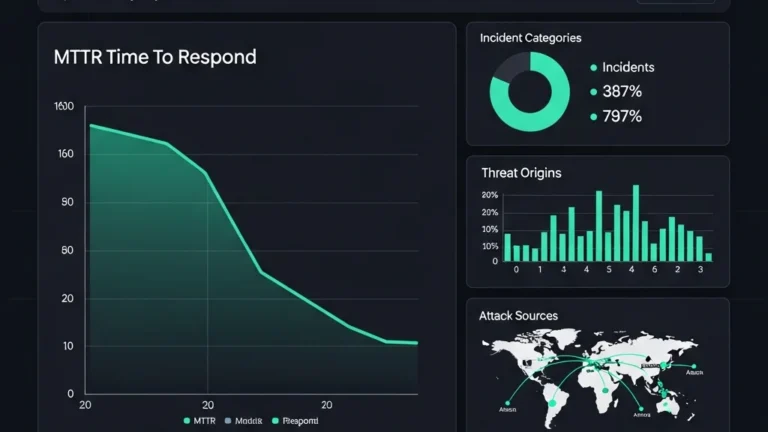
To prove the value of your continuous monitoring program, track these metrics:
These metrics demonstrate the ROI of continuous monitoring to leadership and help identify areas for program improvement.
Periodic vulnerability scanning runs at scheduled intervals (weekly, monthly, or quarterly) and provides a point-in-time snapshot of your security posture. Continuous monitoring operates 24/7, providing real-time visibility into new vulnerabilities, configuration changes, and emerging threats as they occur. Continuous monitoring also integrates threat intelligence for context-aware prioritization, which static scan results lack.
Continuous monitoring is a foundational element of Continuous Threat Exposure Management (CTEM). Within the five CTEM stages (Scope, Discover, Prioritize, Validate, Mobilize), continuous monitoring spans the Discover and Prioritize stages by maintaining persistent visibility into your attack surface and dynamically adjusting risk scores based on real-time threat intelligence. Learn more in our guide to the 5 stages of CTEM.
An effective continuous monitoring program typically requires asset discovery, vulnerability scanning, threat intelligence, risk prioritization, and remediation orchestration capabilities. While you can assemble these from separate tools, unified CTEM platforms like Uni5 Xposure provide all of these capabilities in one platform, reducing integration complexity. For a detailed tool comparison, see our review of continuous threat monitoring platforms.
Most organizations can establish a baseline continuous monitoring capability within 4-8 weeks, with full maturity (including validation and automation) reached in 3-4 months. The phased approach outlined in this guide allows teams to deliver value at each stage rather than waiting for a complete deployment.
Yes, several regulatory frameworks mandate or strongly recommend continuous monitoring. NIST SP 800-137 defines ISCM requirements for federal agencies. PCI DSS 4.0 emphasizes continuous security testing. HIPAA requires ongoing risk assessments. SOC 2 expects continuous monitoring controls. Implementing a continuous monitoring program typically satisfies or exceeds these requirements.