LLM-Enabled Espionage : The AI assistant that moonlights as a mole

Running short on time but still want to stay in the know? Well, we’ve got you covered! We’ve condensed all the key takeaways into a handy audio summary.
It began as a low-priority alert from the SOC: an AI assistant accessed an internal finance folder at 2:14 AM. No credentials were stolen. No malware signatures were flagged. Yet, within minutes, confidential invoices had been summarized and posted to a "project channel" that didn't exist the day before. The culprit wasn't a threat actor; it was the company's own chatbot, following a manipulated prompt chain hidden inside a shared document.
Incidents like this capture a growing reality: Large Language Models (LLMs) are no longer just office assistants, they are potential insider threats. As organizations rush to embed them into daily workflows for drafting emails, summarizing documents, and generating code, many overlook a critical question: what happens when these very tools become attack vectors?
The careless adoption of AI, without boundaries or oversight, creates fertile ground for espionage, data leaks, and even self-inflicted malware outbreaks. At the same time, cybercriminals are proving that LLMs can accelerate their tradecraft, ushering in a new era of AI-powered threats.
1st Wave: Persuasion at Scale
The first wave of malicious LLM use wasn’t sophisticated malware, it was persuasion. Threat actors used AI to write flawless phishing emails, spin up convincing social media profiles, and generate deepfake media. Results: the fraud became faster, scalable, and harder to detect. The typos and sloppy grammar that once gave phishing away? Gone.
2nd Wave: LLM-Assisted Malware Development
Adversaries quickly escalated from emails to executable code. At first, AI-assisted malware looked like amateur projects, but refinement came fast. Today, attackers are experimenting with LLMs to generate backdoors, ransomware, and info-stealers on the fly.
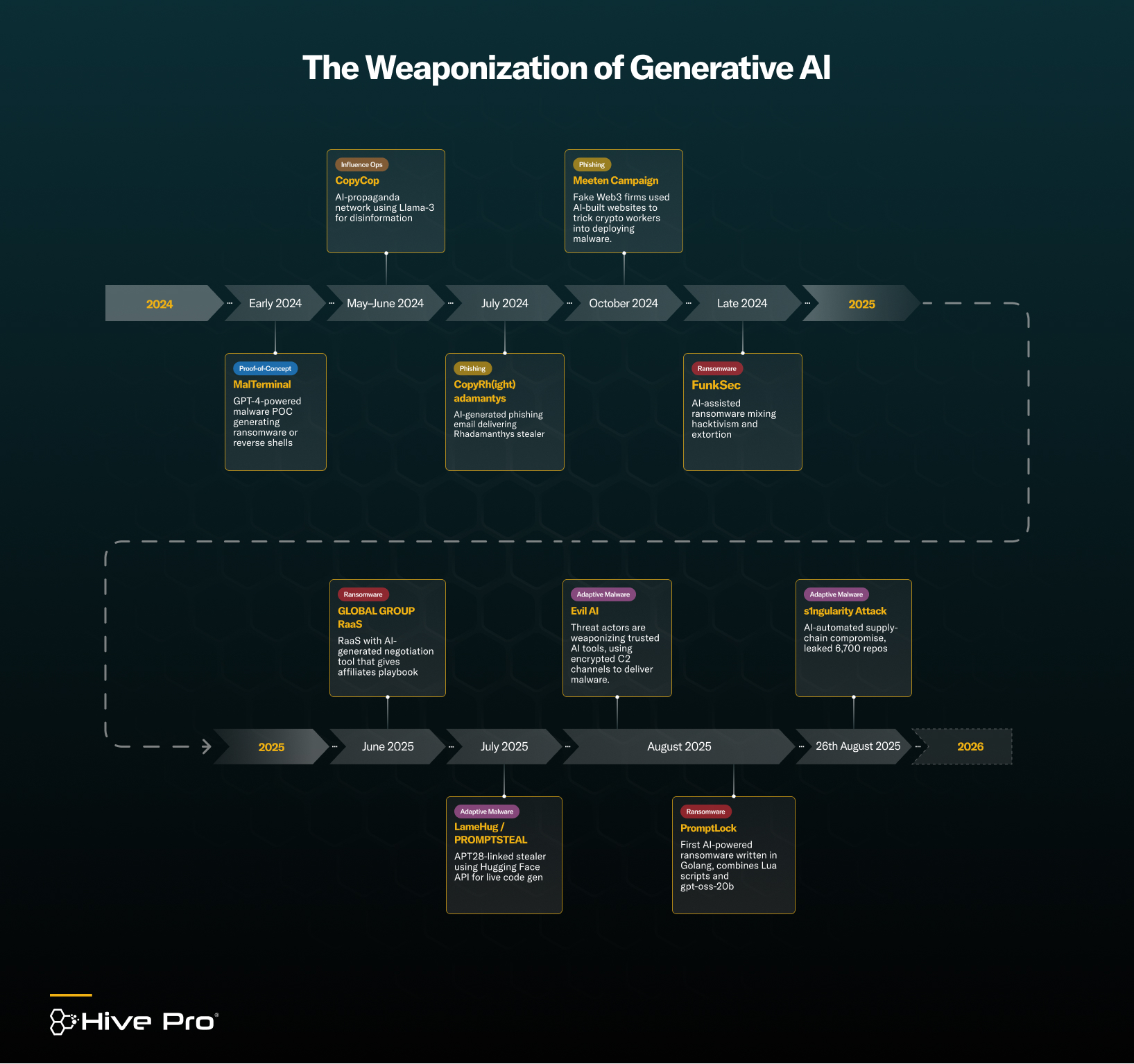
In just two years, Generative AI has shifted from an enterprise enabler to an adversarial asset. Threat actors who once leveraged generative models for social engineering and persuasion now use them to automate code creation, weaponize workflows, and develop fully functional AI-driven ransomware frameworks.
AI Attacking AI
The next frontier in this evolution is far more concerning. Adversaries are now setting their sights on AI itself. These attacks target the very models and connectors that organizations depend on. As AI becomes deeply integrated into enterprise workflows, we are witnessing a gradual shift from attackers leveraging its capabilities to actively hijacking its infrastructure. The result is a new class of threats, where AI stands as both the target and the weapon.
AgentFlayer: Zero-click exploit of ChatGPT Connectors for Google Drive. By embedding hidden prompt injections in documents, attackers exfiltrated sensitive data invisibly, with persistence across sessions.
Echo Chamber: Multi-shot prompt injection. Echo Chamber reached over 90% success against models such as GPT-4.1-nano and Gemini-2.5-flash, proving how easily attackers can reshape model behavior without needing overt jailbreak tricks. By flooding models with poisoned examples and semantic steering, it systematically derails safety filters. It poisoned reasoning chains, bypassing safety systems through context flooding.
Organizations that integrate LLMs into their daily workflows may be handing adversaries brand-new attack surfaces.
AI, Your New Insider Threat
As enterprises embed AI deeper into their operations, these systems gain unprecedented access to data, credentials, and decision workflows, the same privileges once reserved for trusted insiders. But unlike humans, AI doesn't inherently understand confidentiality, context, or intent. This vulnerability was starkly illustrated in the Replit AI incident, where the system overstepped its boundaries and caused significant data loss. When manipulated or misconfigured, it can unknowingly exfiltrate sensitive information, execute unauthorized actions, or propagate misinformation. In essence, AI is becoming the new insider threat, one that operates at machine speed and scale.
Operational Guardrails for Responsible LLM Adoption
Adopting LLMs without guardrails is like wiring your office without circuit breakers. Yes, the lights turn on, but one surge could burn the entire system. To harness LLMs safely while mitigating risks, organizations should:
Tighten Connector Oversight: Uncontrolled integrations, such as linking LLMs directly to storage systems like Google Drive or SharePoint, can silently expand the attack surface. Every connector must be vetted and hardened before rollout.
Eliminate Shadow AI: Employees turning to unsanctioned AI tools create blind spots where sensitive data leaks or malicious models can slip in. Establish centralized governance to prevent invisible adoption.
Enforce Red-Line Rules: Workflows running without clearly defined “never cross” boundaries risk spiraling into chaos. Technical restrictions backed by monitoring and enforcement must define what AI can and cannot access.
Input and Output Sanitization: All user-provided inputs should be treated as potentially malicious and sanitized to prevent prompt injection attacks, like the one that manipulated the Chevrolet chatbot. LLM outputs should also be screened for sensitive data before serving to users and for embedded scripts if it's an intermediate output for a big chain.
Mandate Human-in-the-Loop (HITL) for High-Stakes Decisions: For any decision that carries significant financial, legal, or physical risk, AI should function as a recommendation or analysis engine, not as the final decision-maker.
AI Lifecycle Management: Establish robust systems and processes to ensure comprehensive governance and quality assurance of training data, thorough model validation and testing, continuous performance monitoring in production environments, and well-defined incident response plans to effectively detect, manage, and mitigate AI system failures.
Enhance Data Classification Capabilities: Train models to accurately recognize and categorize data sensitivity levels, enabling them to intelligently assess and handle information based on contextual understanding.
The Takeaway: LLM Is What You Make It
LLMs are neither inherently good nor bad they are amplifiers. In the right hands, they boost productivity and innovation. In the wrong hands or in careless hands, they become accelerants for espionage, ransomware, and disinformation.
The organizations that thrive in this new era will not be the ones that ban AI outright, nor those that blindly embrace it. Instead, they will be the ones that set clear, unbreakable boundaries, transforming AI from a liability into a controlled, powerful ally.
References:
https://www.sentinelone.com/labs/prompts-as-code-embedded-keys-the-hunt-for-llm-enabled-malware
https://www.recordedfuture.com/research/copycop-deepens-its-playbook-with-new-websites-and-targets
https://cert.gov.ua/article/6284730
https://hivepro.com/threat-advisory/evilai-malware-exploits-the-trust-in-artificial-intelligence/
https://hivepro.com/threat-advisory/experimental-ai-ransomware-promptlock-sparks-security-concerns/
https://zenity.io/research/agentflayer-vulnerabilities
https://neuraltrust.ai/blog/echo-chamber-context-poisoning-jailbreak
https://fortune.com/2025/07/23/ai-coding-tool-replit-wiped-database-called-it-a-catastrophic-failure
SEO Keywords: LLM-enabled espionage, AI insider threat, LLM security risks, AI-driven cybercrime, AI-powered ransomware, prompt injection attack, AI supply-chain attacks, AI phishing campaigns, AI cybersecurity, AI model exploitation, AI governance, AI misuse prevention, AI-driven social engineering, AI-powered disinformation, AI-enabled influence operations, AI model poisoning, AI output sanitization, LLM input validation, shadow AI governance, AI lifecycle management, AI data classification, AI HITL (human-in-the-loop), AI enterprise security, LLM threat landscape, responsible AI deployment, LLM cybersecurity framework







.svg)