IE Mode: A Window to the Web - or to Attackers?

Running short on time but still want to stay in the know? Well, we’ve got you covered! We’ve condensed all the key takeaways into a handy audio summary. Our AI-driven podcasts are fit for on the go.
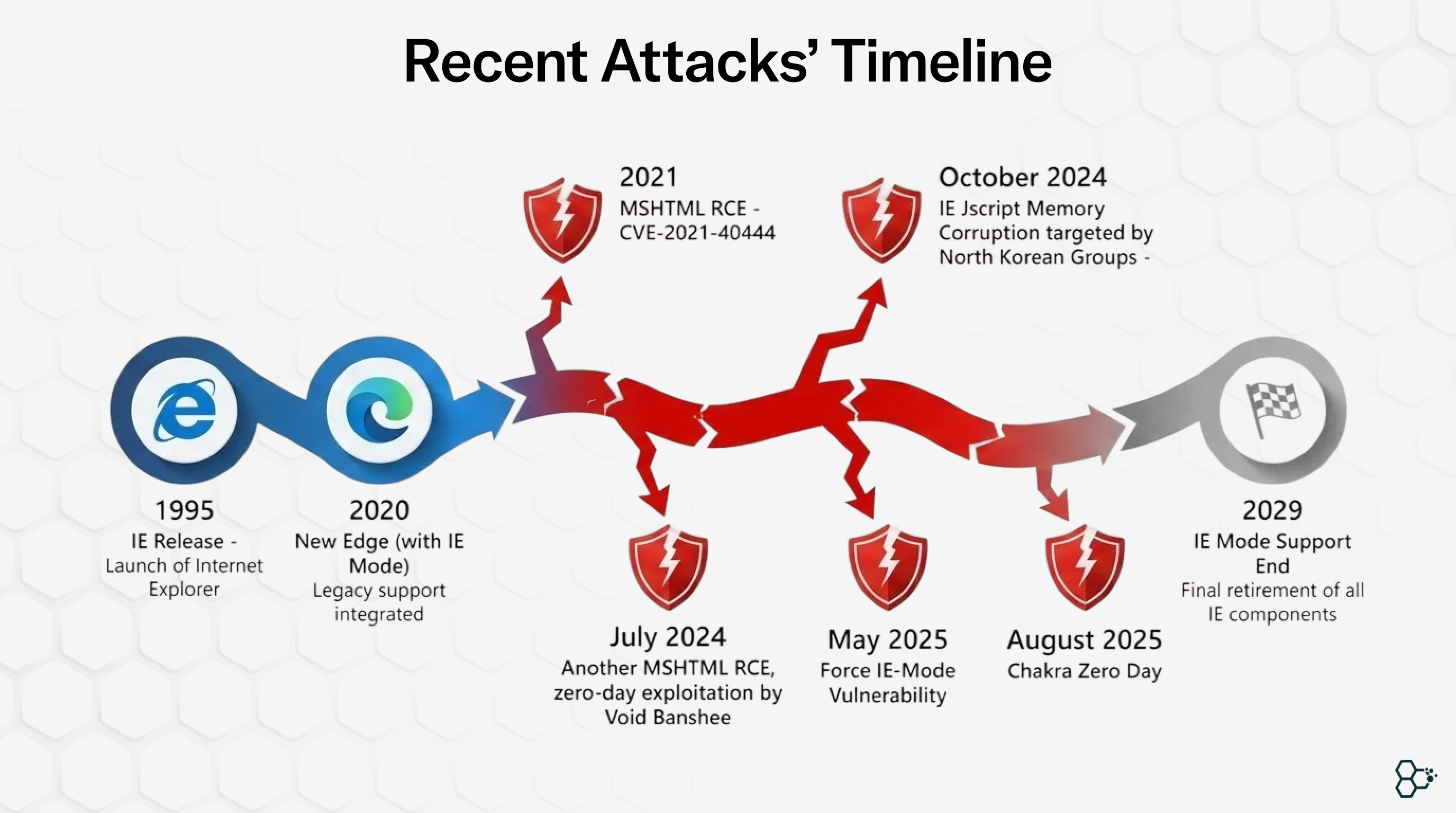
Recently, Internet Explorer (IE) Mode has been weaponized by threat actors through multiple zero-day exploits.
- One such vulnerability, CVE-2025-30397, allowed attackers to force Microsoft Edge into IE Mode, leading to potential exploitation of legacy components.
- In August 2025, another zero-day vulnerability prompted Microsoft to introduce additional restrictions on IE Mode to mitigate abuse.
- The threat actors had discovered they could weaponize the IE Mode feature by combining two key elements: social engineering tactics and unpatched zero-day vulnerabilities in the Chakra JavaScript engine.
- The attack unfolded through Social Engineering, with attackers creating a phishing website and putting a flyout notification: "This page works best in Internet Explorer mode. Click here to reload."
- The one who complied, inadvertently loaded the page in IE mode, enabling attackers to deploy an unpatched zero-day exploit against Chakra, IE's JavaScript engine, and ultimately achieving remote code execution.
- The attackers further deployed a second exploit designed specifically for privilege escalation. This second vulnerability allowed them to break out of the browser entirely and escalate to SYSTEM level privileges. Attackers now own the system and possibly the infrastructure.
- Previously, in 2024, the Void Banshee threat group exploited CVE-2024-38112, further demonstrating the persistent risks associated with IE Mode compatibility features.
But a key question to ponder upon, why does internet explorer mode still exist?
Why—Internet Explorer Mode Exists
It’s a Legacy trap: Organizations across the globe have invested decades into building internal web applications specifically for Internet Explorer. These aren't new applications—they're often mission-critical systems built on older technologies like ActiveX controls, Flash, Silverlight, and legacy JavaScript frameworks that modern browsers intentionally abandoned for security reasons.
In January 2020, Microsoft released its new Chromium-based Edge browser, which included an Internet Explorer (IE) Mode. This feature provided a balanced solution for businesses that relied on legacy web applications. With IE Mode, users could benefit from the modern, secure browsing experience of the Chromium platform, while organizations could configure specific domains to render using the Internet Explorer 11 engine.
It was a win-win for Microsoft with an assumption that by limiting IE Mode to designated sites, the attack surface would stay minimal. Malicious sites wouldn’t be able to trigger it, and users would only enable it intentionally for trusted, business-critical pages. That assumption proved wrong.
Real-World Impact
Enterprises operating legacy systems with IE Mode enabled at their endpoints are the ones most at risk. These organizations should exercise extreme caution, as the August zero-day vulnerability likely remains unpatched, with the CVE still undisclosed by Microsoft. Compounding the risk, IE Mode will continue to be supported until 2029, keeping these outdated, vulnerable applications within otherwise secure environments.Although Microsoft has introduced additional restrictions around IE Mode, it remains uncertain whether these measures are sufficient. Embedding a legacy, vulnerability-prone technology within a modern browser raises serious questions about the limits of trust in contemporary browser security controls.
Recommendations
- Organizations are strongly advised to modernize their legacy applications and disable IE Mode through Group Policy across all endpoints to minimize exposure. For endpoints that require IE Mode, implement an allowlist of specific trusted URLs rather than enabling it broadly.
- Prioritize Microsoft Edge and Windows security updates, especially those addressing IE Mode and legacy rendering engines.
- Block or quarantine access to IE Mode-required sites from general browsing environments. Consider using dedicated, isolated machines or virtual desktops for legacy application access.
- Train employees to recognize social engineering tactics, especially prompts asking to "switch to IE Mode" or "reload in compatibility mode". The August 2025 attack relied entirely on users clicking a fake flyout notification.
- Update incident response playbooks to include IE Mode exploitation scenarios. Define containment steps for compromised endpoints with IE Mode enabled.
References
https://microsoftedge.github.io/edgevr/posts/Changes-to-Internet-Explorer-Mode-in-Microsoft-Edge







.svg)